In this guide
A rating needs context
Duty cycle describes how long equipment can operate at a stated load within its specified cycle. Many welding machines use a ten-minute basis. Always check the manufacturer’s manual for the cycle, output and test conditions.
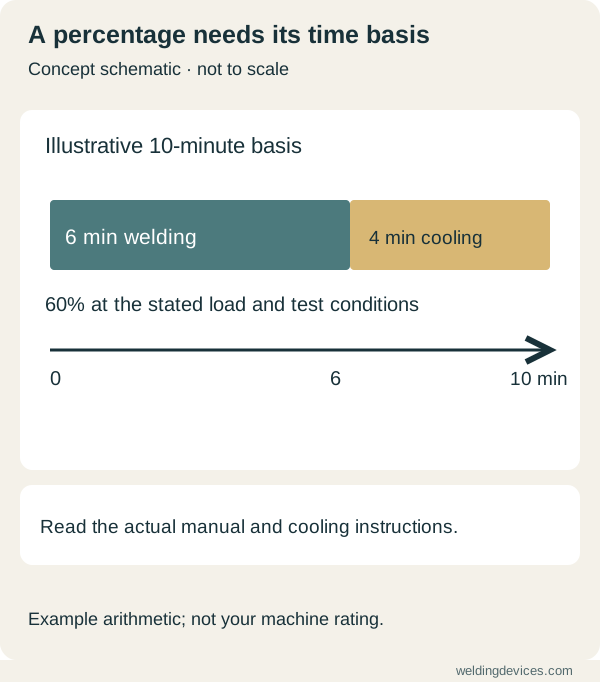
Schematic; source.
A ten-minute example
On a ten-minute basis, a 60% rating means six minutes at the rated load followed by four minutes for cooling. A 30% rating means three minutes welding and seven minutes cooling. These examples explain the arithmetic; they do not establish the rating of your machine.
Compare the same operating point
Two machines may both display “200 A” while offering different duty cycles at that output. Read the complete rating or curve. A rating at a lower current cannot be substituted for one at the current your job requires.
Workshop example
If your work consists of a few short tacks followed by lengthy fit-up, your arc-on pattern differs from a long continuous run. Write down the longest expected run and compare it with the manual before choosing the machine.
Use the cooling period correctly
Follow the maker’s cooling instructions, keep the ventilation path clear and maintain the equipment as specified. Do not treat the thermal cut-out as a normal way to decide when to stop.
The calculator on the equipment page illustrates percentages over ten minutes. It does not predict temperature or change a manufacturer’s duty-cycle rating.
Work through a labelled example
Imagine a specification stating 60 percent at a particular output on a ten-minute basis. That describes six minutes of welding within the specified cycle and four minutes of the required cooling period, under the conditions stated by the manufacturer. It does not mean six minutes at every current setting. The output and test conditions belong beside the percentage whenever you compare machines.
Now imagine a second rating of 100 percent at a lower output. Those two entries can both describe the same machine. The lower-output rating may be more relevant to your normal work. Write your expected working range next to each candidate's published duty-cycle table. You can then compare the capacity you will use, rather than the largest number on the product page.
Look at your real work rhythm
An occasional hobby project may involve long periods of measuring, fitting and repositioning between short welds. A production task may involve repeated runs with far less time away from the arc. Neither rhythm is adequately described by saying that you weld for an hour. Break a representative job into welding, preparation, inspection and handling so that the equipment discussion has a practical basis.
Do not use natural pauses as permission to exceed the machine's instructions. Instead, ask whether the published rating supports the intended task. A supplier can help identify the appropriate output and operating conditions, while the manual defines the equipment limits. If a job regularly approaches those limits, compare a better-suited system rather than relying on thermal shutdown as a normal timer.
Check the rest of the welding circuit
The power source is only one part of the equipment. A torch, cable assembly or other accessory may have its own rating and cooling requirements. Confirm compatibility and the relevant duty-cycle basis for the complete package. A high-output power source paired with an unsuitable torch does not become a complete production solution because both connectors fit.
Include the cooling arrangement and any required coolant equipment in the quote. Check where hoses and cables will run, how routine inspection will work and who supplies replacements. Ask the supplier which component sets the practical limit in your chosen configuration. The answer should identify documented ratings, rather than assume that every accessory shown with the machine matches its maximum advertised capacity.
Read thermal protection correctly
A warning or shutdown is information that the machine needs attention according to its manual. Record the operating conditions and follow the stated cooling and restart instructions. Do not bypass protection, obstruct cooling or improvise an internal repair. Repeated interruptions deserve a review of application, supply, environment and equipment condition by a competent person.
A small log can help that review. Note the process, approximate output, length of the welding periods, ambient conditions and displayed warning. Avoid guessing an internal temperature or diagnosing a component from one symptom. Supply the log and exact model details to the service provider. A clear record is more helpful than the complaint that the machine occasionally becomes too hot.
Ask better buying questions
Ask for the duty-cycle table at your expected working output, the relevant test conditions and the rating of the included torch. Confirm input-supply requirements separately: a duty-cycle figure does not establish that your socket and circuit can provide the necessary power. Have a qualified electrician assess installation questions that the manual cannot resolve for your premises.
When comparing quotes, keep these answers beside the package price and service terms. The machine catalogue provides a place to begin that research, while the official manuals help you find the full documentation. Choose useful capacity for a realistic job. A percentage makes sense only after you know what equipment, output and operating conditions it describes.
Put the choice in context.
Try the welding process finder to narrow your equipment research, or compare a complete setup in the ownership cost calculator.
References
Open the publisher’s page. If a new tab fails, use “Open directly” or copy the address into your browser.
- Miller — Duty cycle and why it matters · sourceOpens the source in a new tabmillerwelds.comLink checked · 31 Oct
- Miller — Current owner manuals and duty-cycle chartsOpens the source in a new tabmillerwelds.comLink checked · 31 Oct
