
MIG, TIG or stick: choose the process for the job
A practical comparison of control, speed, preparation and working conditions.
Understand a process, solve a problem, or learn about equipment and new technology.
47 guides
A practical comparison of control, speed, preparation and working conditions.
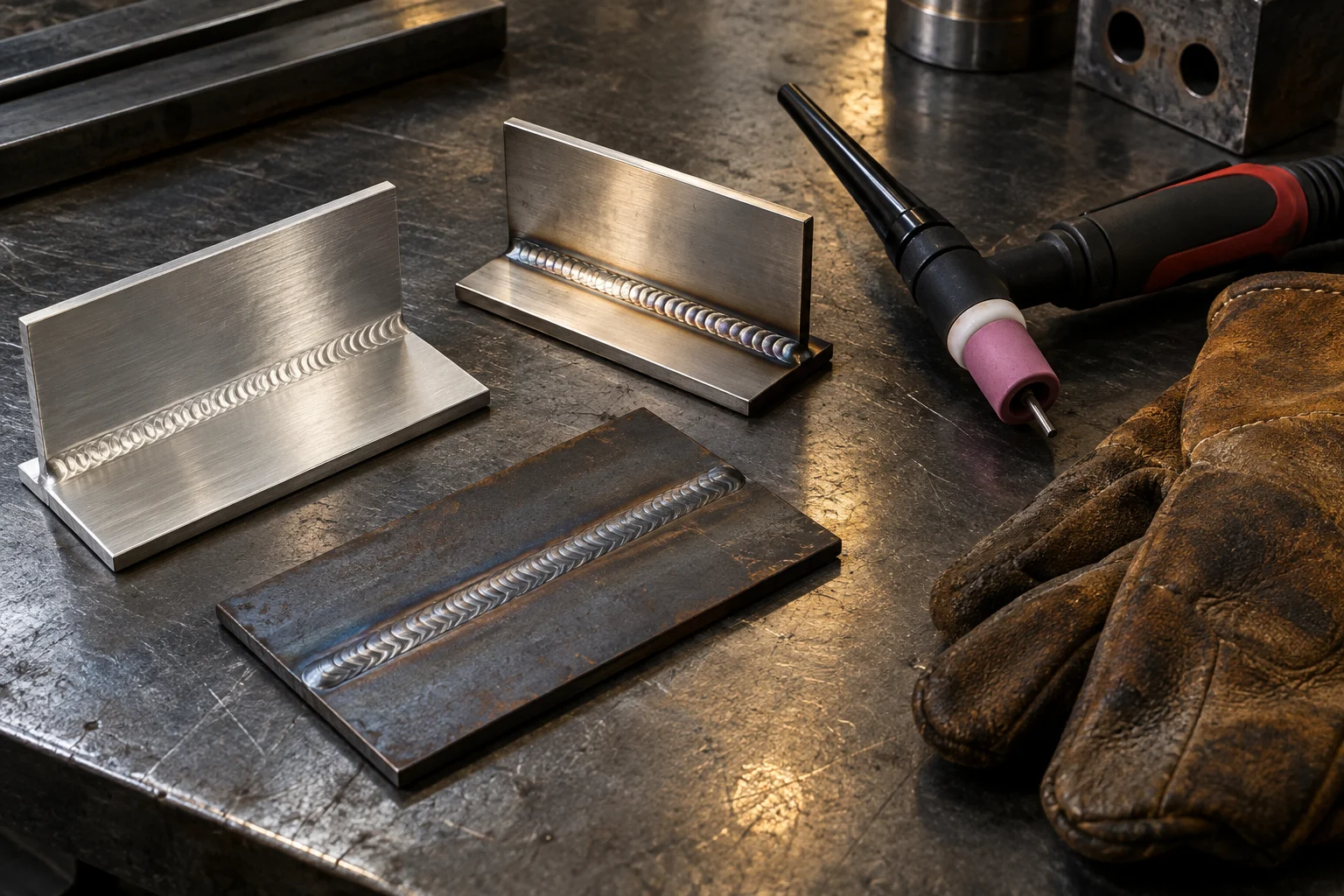
Oxide removal, alloy identification and wire feeding explained before you choose a process.
Understand peak and background current, and where pulse can make a useful difference.
Distinguish a through-opening from distortion and excess penetration, then record thickness, fit-up and local heating before changing settings.
Learn how to record a sudden increase in MIG spatter, check consumable identity and separate equipment, distance and arc-control questions.
Learn what lack of fusion means, why access and travel matter, and how to organise a controlled investigation before changing settings.
Understand why a TIG weld can end in a hollow, how current and filler coordination matter, and when a suspect termination needs assessment.
Learn where slag can remain between weld passes, how to organise a cleaning checkpoint and why a clean surface cannot prove internal soundness.
Learn to recognise possible MIG undercut, record where it appears and investigate setup and movement before changing settings.
Understand why removing a zinc coating does not complete the welding safety plan, and what to verify before preparing galvanised steel.
Learn what DCEP and DCEN mean, why two flux-cored wires can require opposite polarity, and what to verify before changing a spool.
Learn what TIG post-flow protects, why timer ranges differ by machine and how to check your setup without guessing a universal setting.
Learn how electrode extension, stickout and contact-tip-to-work distance affect a constant-voltage MIG arc—and how to control them.
Understand magnetic arc blow, record a directional arc pull and plan a controlled investigation of the work-return arrangement.
Learn how to recognise likely TIG tungsten contamination, stop safely, reprepare the electrode and avoid chasing unrelated settings.
Learn how to store opened low-hydrogen stick electrodes, separate holding from redrying and handle rods with an unknown exposure history.
Learn to recognise three common wire-feed symptoms, understand the feed path and record useful evidence before changing settings.
Understand joint types, preparation, fit-up checks and the limits of visual inspection before your next supervised practice exercise.
Learn to separate gun position from travel movement, compare labelled practice coupons and keep useful technique notes.
Learn setup checks, gun angles, straight beads and a repeatable inspection routine for supervised MIG/MAG practice.
Build TIG coordination through isolated hand practice, supervised pool control, filler timing and careful sample review.
Learn electrode checks, isolated movement practice, short arcs, restarts and slag-aware inspection for supervised MMA/SMAW sessions.
Passive or auto-darkening? Compare shade range, arc detection, fit and replacement lenses.
Understand the difference between fine torch control and protection from heavier heat and spatter.
Build a complete protection kit for welding, preparation and clean-up.
Why a welding helmet is not a respirator, and why moving air is not the same as capturing fume.
The supporting equipment that makes preparation and fit-up easier to repeat.
Compare occasional preparation, repeat straight cuts and plasma cutting as complete workflows.
Understand the accessories that keep wire feeding, gas delivery and maintenance working together.
Compare lower-cost welding devices by the jobs they support and the cost of the complete setup.
A practical checklist for condition, accessories, parts support and the cost of making a used machine usable.
Start with simple fixtures, measuring aids and tool organisers around a properly supported welding machine.
Start with the material, the work space and a complete setup budget before choosing a machine.
Compare the duty cycle, electrical supply, feeding system and service arrangements against actual paid work.
Use purchase, setup and running costs to compare alternatives on consistent assumptions.
Compare process capability, available power, useful output and the complete setup.
Translate a percentage into arc time, then compare it at the right output.
Why grade, heat control and the finished surface matter to a stainless joint.
A structured way to investigate pinholes and trapped gas in a weld.
Why one gas bottle cannot be assumed to suit every welding task.
Concentrated heat, fit-up requirements and a very different safety environment.
Seam tracking, inspection and repeatable parts explained without the automation hype.
Separate current polarity, AC balance and pulsing before comparing TIG machines.
Fit-up, tacking and welding sequence can matter as much as the current setting.
Compare solid-wire MIG/MAG, self-shielded flux-core and gas-shielded flux-core by work area, setup, total cost and practical limitations.
Fume control, protection, fire prevention and people around you belong in the setup.
An example of guided sequences and production records, with the manufacturer’s claims kept in context.