
In this guide
Start with the job
A long run on a steel frame and a small visible joint in thin sheet ask different things of a welder. Decide what material you have, how the joint must perform, where you will work, and how much finishing you can accept.
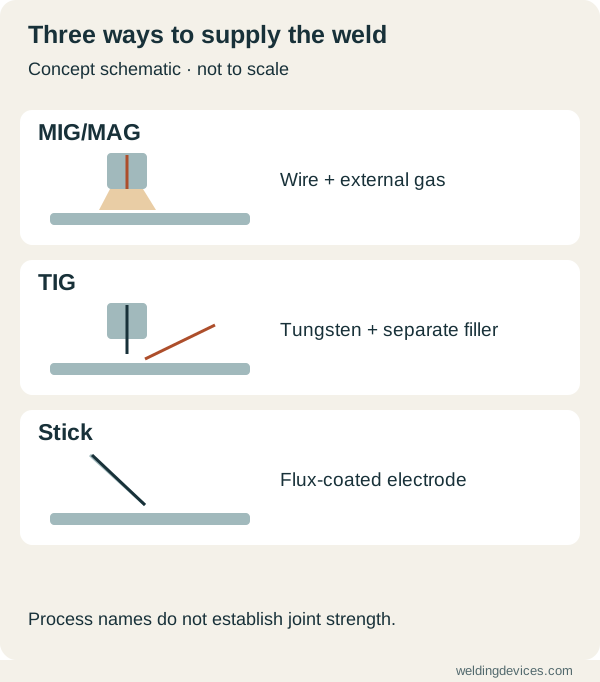
Schematic; source. Stick process source.
What each process brings
MIG/MAG (GMAW) feeds a consumable wire continuously. It is often convenient for workshop fabrication and repeated joints. The external shielding gas needs protection from draughts. MIG uses inert shielding gas; MAG uses an active gas or mixture.
TIG (GTAW) uses a tungsten electrode, with filler added separately when needed. It offers precise control and a clean finish, but needs coordinated technique and usually more time.
Stick (MMA/SMAW) uses a flux-coated electrode. Portability and the absence of a separate shielding-gas cylinder make it a useful option for suitable outdoor steel work. Electrode changes and slag removal interrupt the work.
Workshop example
Imagine two practice tasks: several repeat joints on a mild-steel bracket, and a small stainless-steel edge where appearance matters. Compare MIG/MAG for the first and TIG for the second. These are starting points for evaluation; neither process name proves that a joint is sound.
What to check next
- Match the electrode or wire to the actual base material and service conditions.
- Check that the power source supports the required process, output and polarity.
- Use a suitable procedure and practice on matching scrap before making the part.
For load-bearing, pressure-containing or safety-critical work, use a qualified procedure and appropriate inspection. A tidy bead alone does not establish strength.
Imagine the same project three ways
A useful comparison starts with something ordinary, such as a small steel workshop shelf. With MIG/MAG, you would plan access for the gun, a compatible wire and gas package, and a sheltered work area. With TIG, you would need room for both the torch and filler hand, plus more deliberate preparation. With stick, you would plan electrode changes and slag removal around the joints. The finished shelf might look similar, while the work behind it differs considerably.
Now change the project to a visible joint in thin sheet. That changes the importance of heat control, fit-up and finishing. Change it again to an outdoor repair and shielding becomes a bigger part of the decision. This exercise prevents you from treating one process as a universal winner. Write down which constraint actually matters before looking for features that solve it.
Learning effort is part of the equipment choice
A first lesson should make the process understandable, not promise instant competence. MIG practice can begin with maintaining a consistent gun position and watching how a straight bead develops. TIG practice separates torch movement from filler feeding before combining them. Stick practice introduces arc starting, controlled electrode movement and the need to maintain the arc as the electrode becomes shorter.
Those are different coordination tasks. If you can borrow equipment or attend a supervised introductory session, compare how comfortably you can see the joint and repeat the movement. Keep the material and exercise similar. A demonstration by an experienced operator shows capability; your own supervised trial helps identify the training you will need. Use the learning paths to choose a starting lesson.
Ask for an honest demonstration
Bring a drawing, material description and realistic joint to a supplier rather than asking for the prettiest sample. Ask to see the preparation, setup, start, finish and inspection. A demonstration that begins with perfectly prepared coupons may be useful, but it does not tell you how long preparation takes in your workshop.
Record the exact machine configuration and consumables. Ask whether the demonstrated accessories are included in the quotation. Note how easily you can reach a corner, replace a consumable and see the weld pool. Where the project needs a documented procedure or qualified personnel, make those requirements explicit before the demonstration. The equipment decision should follow the application, rather than quietly redefine it.
Compare work beyond arc time
Suppose one process lays the bead faster but leaves more cleanup, while another takes longer at the arc and fits the finish requirement better. Your decision needs the complete sequence: cutting, preparation, fitting, welding, inspection and finishing. For a hobbyist, ease of learning or convenient storage may outweigh a small difference in arc speed. For repeat production, access, consistency and changeover time may matter more.
Include training, gas arrangements, extraction, protective equipment and consumables in the first budget. Check whether your electrical supply supports the intended output. Two machines carrying similar amperage labels may require different supplies or offer different useful working periods. Compare a complete setup through the equipment guides, then use actual quotations in the cost calculator.
Common questions before choosing
Is TIG always stronger? Strength depends on the material, joint, procedure and acceptance requirements. A clean surface does not settle that question. Is stick only for rough work? Its usefulness depends on the electrode and application; appearance alone is an incomplete comparison. Is MIG always easiest? A convenient wire feed does not remove the need to understand shielding, preparation and inspection.
Make a short decision note with the project, chosen process, rejected alternatives and unresolved questions. That gives you something concrete to discuss with a trainer or supplier. Revisit it when the material, location or finish requirement changes. A good process choice is one you can explain in terms of the work in front of you.
Put the choice in context.
Try the welding process finder to narrow your equipment research, or compare a complete setup in the ownership cost calculator.
References
Open the publisher’s page. If a new tab fails, use “Open directly” or copy the address into your browser.
- TWI — MIG versus TIG · sourceOpens the source in a new tabtwi-global.comLink checked · 31 Oct
- Miller — Choosing filler metal for DIY welding projectsOpens the source in a new tabmillerwelds.comLink checked · 31 Oct
- TWI — MIG and MAG welding explainedOpens the source in a new tabtwi-global.comLink checked · 31 Oct
- Miller — Stick welding technique · Stick process sourceOpens the source in a new tabmillerwelds.comLink checked · 31 Oct