In this guide
Choosing a wire is easier when you start with where the work happens. Picture two jobs: a small steel frame on a sheltered workshop bench, and a repair that has to happen outside. The same machine may appear in both plans, but shielding, consumables and preparation deserve a fresh look.
Before buying a spool, establish whether you are comparing solid wire, self-shielded flux-cored wire or gas-shielded flux-cored wire. Those three names describe different setups. The word “flux-core” alone leaves an important question unanswered.
The three wire setups in plain language
Solid-wire MIG/MAG uses a continuously fed wire and external shielding gas. The gas protects the weld pool; draughts can disrupt that protection. MIG and MAG are versions of the same broad process, distinguished by the shielding gas used.
Self-shielded flux-cored wire develops shielding from ingredients within the wire. It avoids a separate shielding-gas cylinder. Gas-shielded flux-cored wire combines its internal flux with an external gas supply. Read the exact consumable data sheet to identify which type you have.
“Gasless” is a common buying label for the self-shielded route. It describes the cylinder requirement, and does not establish suitability for a particular material, joint or service condition.
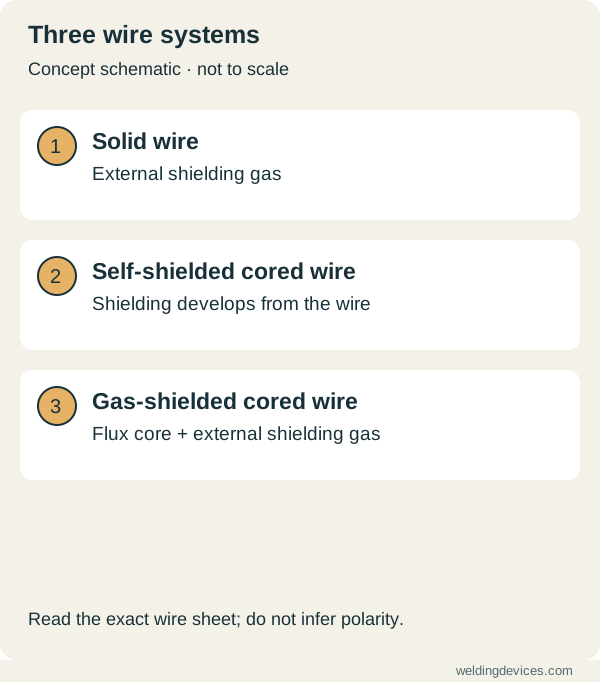
Schematic; source.
Start with the place you will work
For the imagined sheltered bench project, write down the materials, joint sizes and available electrical supply before looking at machines. Then compare complete solid-wire and self-shielded packages. A lower machine price is only one line in that comparison.
For the outdoor job, ask how shielding will be protected. A self-shielded wire may be worth investigating for a suitable application, but outdoor conditions still matter. Moving a job into shelter can also change the options. Avoid treating a process label as permission to weld in every location.
If a part supports people, lifting equipment, a vehicle or a pressure system, begin with competent assessment and the applicable procedure. Shopping comparisons cannot establish that a repair is acceptable.
Check the machine and wire together
A product listing saying “MIG” or “multiprocess” gives you a starting category. Before purchasing, check the exact machine manual against the intended consumable.
Ask the supplier to confirm:
- Whether the machine supports the intended solid or flux-cored wire.
- The compatible wire sizes, feeding parts and required configuration.
- Whether the required polarity arrangement is available and documented.
- Which torch, gas accessories and consumables are included in the quoted package.
- Where replacement parts and local service will come from.
Keep the answer attached to the exact model and regional package. An accessory shown in a photograph is not proof that it is included. The machine catalogue keeps specifications, package notes and references together so you can investigate further.
Also read the wire data sheet for its base-material compatibility, permitted application, welding positions, storage and handling. Never infer polarity from the name “flux-core.” Lincoln specifies electrode negative for Innershield NR-211-MP, while its gas-shielded Outershield 71M sheet specifies electrode positive. These are product-specific manufacturer requirements, checked 24 October 2026. Our wire-polarity lesson explains DCEP and DCEN and how to verify the supported machine configuration. Keep these checks with your equipment plan.
Compare the complete cost
Put two complete setups on paper. For a gas-shielded option, include the cylinder arrangement, regulator, hoses and the supplier's ongoing gas costs. For either option, include compatible consumables, preparation tools, protection and fume controls.
Add costs that reflect your own situation. A hobby project and a workshop with regular work can have very different priorities. Use the ownership cost calculator with actual quotes rather than assuming one process will always be cheaper.
Time also deserves a question. Flux-cored processes produce slag that needs attention; solid wire does not use that flux system. Ask how preparation and finishing will fit your intended work, rather than estimating productivity from a headline amperage rating.
Plan protection before practice
The absence of a shielding-gas bottle does not remove welding fume or other hazards. HSE's guidance puts exposure reduction first, then appropriate extraction and respiratory protection where needed. Outdoor work still requires suitable exposure controls.
Read the welding safety guide and protective equipment guide. Follow local requirements and the exact equipment instructions. This comparison explains choices; it does not provide operating settings or a qualified welding procedure.
Questions that often come up
Does all flux-cored wire work without gas?
No. Check whether the specified wire is self-shielded or gas-shielded. The spool's classification and manufacturer instructions matter more than a broad shop category.
Can I switch wire in any MIG machine?
Confirm compatibility in the actual manual. A change may involve feeding parts, polarity or gas equipment. Have the supplier identify the supported configuration before you commit to a purchase.
Which choice produces a stronger weld?
A process name cannot answer that. The actual material, joint design, procedure and inspection determine suitability. A tidy-looking bead is not an acceptance test.
What is a sensible next step?
Use the welding process finder to narrow your reading, then compare two or three complete equipment packages. Keep your material, working area and intended application visible while you compare.
A useful practice comparison
If both setups support your intended application, ask an instructor to plan equivalent practice coupons. Keep the material and joint consistent and record the wire, shielding arrangement, preparation and result. Include slag removal and inspection in the comparison. That gives you a more useful learning record than choosing the cleaner-looking bead from two unrelated demonstrations.
Put the choice in context.
Try the welding process finder to narrow your equipment research, or compare a complete setup in the ownership cost calculator.
References
Open the publisher’s page. If a new tab fails, use “Open directly” or copy the address into your browser.
- Miller — Solid wire versus flux-cored wire · sourceOpens the source in a new tabmillerwelds.comLink checked · 31 Oct
- TWI — Gas metal arc welding, MIG and MAGOpens the source in a new tabtwi-global.comLink checked · 31 Oct
- HSE — Welding fume exposure controlsOpens the source in a new tabhse.gov.ukLink checked · 31 Oct
- Lincoln Electric — Innershield NR-211-MP, AU/NZ consumables sheet · Innershield NR-211-MPOpens the source in a new tabch-delivery.lincolnelectric.comLink checked · 31 Oct
- Lincoln Electric — Outershield 71M product information, D-69–D-70 · Outershield 71M sheetOpens the source in a new tabch-delivery.lincolnelectric.comLink checked · 31 Oct
