In this guide
Reader question: Do I need to change polarity when switching from solid wire to flux-cored wire?
Direct answer: Check the exact wire's instructions and your machine manual before deciding. Some flux-cored wires require electrode negative; others use electrode positive. “Flux-cored” alone does not identify the connection. Two Lincoln consumables below demonstrate why a remembered rule can be misleading.
Learning objective: You will be able to translate DCEP and DCEN into wire and work connections, compare two documented consumables, and prepare a safe verification checklist before a wire change.
What electrode positive and negative mean
In wire welding, the electrode is the wire. DCEP means direct current electrode positive; DCEN means direct current electrode negative. Older instructions may call these reverse and straight polarity respectively. TWI defines these terms for DC welding electrodes, including wire. Read the full abbreviation rather than remembering “positive welding” without identifying what is positive.
With DCEP, the wire side of the welding output is positive and the work return is negative. With DCEN, those output connections are reversed. This describes the welding circuit, not the machine's protective earth connection. Never alter protective earthing to change welding polarity.
Make a simple written note with three entries: wire name, required polarity, and matching manual diagram. This turns an unfamiliar abbreviation into something you can verify. Our solid-wire and flux-cored comparison explains the wider shielding and equipment choices.
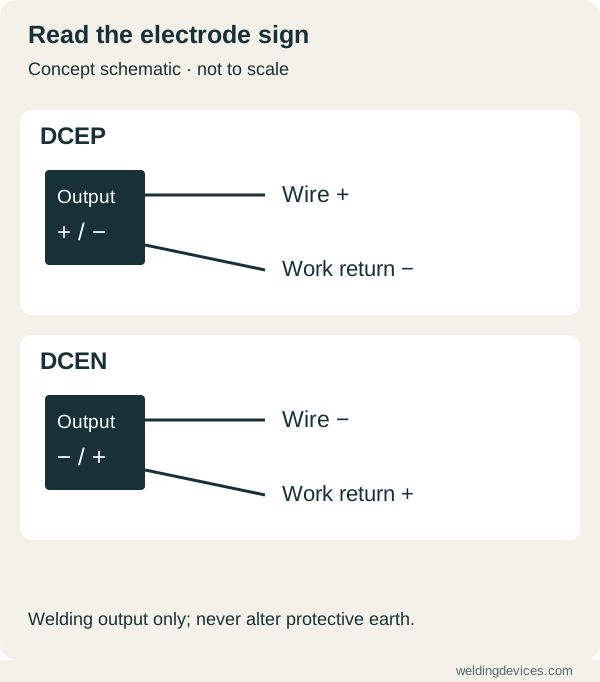
Schematic; source.
Two flux-cored wires, different requirements
Lincoln's Australian/New Zealand consumables sheet identifies Innershield NR-211-MP as self-shielded and specifies DC negative. The polarity note appears beneath its diameter and operating table. This is a manufacturer requirement for that product, rather than evidence that every self-shielded wire uses the same connection. Read the NR-211-MP sheet.
Lincoln's Outershield 71M sheet describes a gas-shielded flux-cored wire. Its typical operating tables specify DC positive, and the document lists external shielding-gas options. Turning off the gas does not turn this consumable into a self-shielded wire. Read the Outershield 71M sheet.
Both examples come from Lincoln, so they are product-specific instructions from one manufacturer. They demonstrate different requirements within the flux-cored family; they are not independent product tests. Neither example establishes a suitable wire, gas or procedure for your particular joint.
Read the label as an identity check
Keep the trade name, full classification, diameter and packaging label together. A partial description such as “steel flux wire” loses information needed to find the applicable instructions. Match the actual spool to the manufacturer's sheet, including regional variants or revisions.
A classification is a standardised consumable identification. TWI explains that cored-wire usability designators communicate operating characteristics including polarity, external shielding requirements and single-pass or multipass use. Its carbon-steel consumables lesson explains the classification systems. Use that information to understand the label, then confirm the exact product instructions.
If a seller's short description and the manufacturer's sheet disagree, stop and resolve the identity or revision with the supplier. Do not settle the disagreement by striking an arc on the workpiece. A practice bead cannot replace missing product information.
Check the supported machine configuration
For a concrete equipment example, the Millermatic 211 manual OM-265809C, dated March 2016, shows solid-wire DCEP and self-shielded-wire DCEN connections. It also tells readers to follow the wire manufacturer's polarity recommendation. Its scope is that documented machine version, not every Millermatic 211 or every cored wire.
The same manual warns about live circuits and requires input-power disconnection before installation or servicing. Follow the applicable manual's shutdown, isolation and operator-access instructions before any permitted connection change. Do not open electrical service compartments to improvise a conversion. See Miller's safety section and sections 5-8 and 5-9.
Polarity is one setup item. Check the supported wire diameter, feeding parts, gun consumables and shielding arrangement too. Our wire-feed troubleshooting lesson explains why a spool change also deserves a feed-path check.
Hypothetical worked example: catch the mismatch first
Imagine a learner preparing a supervised mild-steel practice session. The machine was previously configured for solid wire with electrode positive. The new spool is clearly labelled NR-211-MP, and its matching sheet specifies electrode negative.
Before loading or connecting anything, the learner records the mismatch and finds the exact machine manual. If the machine supports the intended consumable and an authorised polarity change, they follow that procedure with the equipment isolated as required. If compatibility is unclear, the session pauses for supplier or instructor guidance.
Later, someone offers Outershield 71M as another “flux-core” option. The learner checks its separate sheet instead of carrying over the earlier conclusion. The new document identifies electrode positive and external shielding. No voltage, wire speed or successful weld result is assumed in this example.
Checklist before a wire change
- Identify the exact spool, diameter and full classification.
- Confirm its polarity and shielding requirements in the applicable sheet.
- Match those requirements to the machine's supported configuration.
- Follow shutdown and isolation instructions before permitted changes.
- Check compatible feeding parts and consumables.
- Keep the setup record with your practice notes.
Self-check: Does a flux-cored label prove the gun should connect to negative?
Answer: No. NR-211-MP and Outershield 71M provide opposite documented examples. Verify the exact wire and machine instructions first. Correct polarity is one requirement; it does not establish weld acceptance or suitability for safety-critical work.
Put the choice in context.
Try the welding process finder to narrow your equipment research, or compare a complete setup in the ownership cost calculator.
References
Open the publisher’s page. If a new tab fails, use “Open directly” or copy the address into your browser.
- Lincoln Electric — Innershield NR-211-MP, AU/NZ consumables sheet · Read the NR-211-MP sheetOpens the source in a new tabch-delivery.lincolnelectric.comLink checked · 31 Oct
- Lincoln Electric — Outershield 71M product information, D-69–D-70 · Read the Outershield 71M sheetOpens the source in a new tabch-delivery.lincolnelectric.comLink checked · 31 Oct
- Miller — Millermatic 211 OM-265809C, March 2016 · See Miller's safety section and sections 5-8 and 5-9Opens the source in a new tabmillerwelds.comLink checked · 31 Oct
