In this guide
A concentrated heat source
Laser welding uses a focused beam to form a joint. Depending on the system and application, it can support high travel speeds and narrow welds. Results depend on material, joint geometry, fit-up, filler and the process configuration.
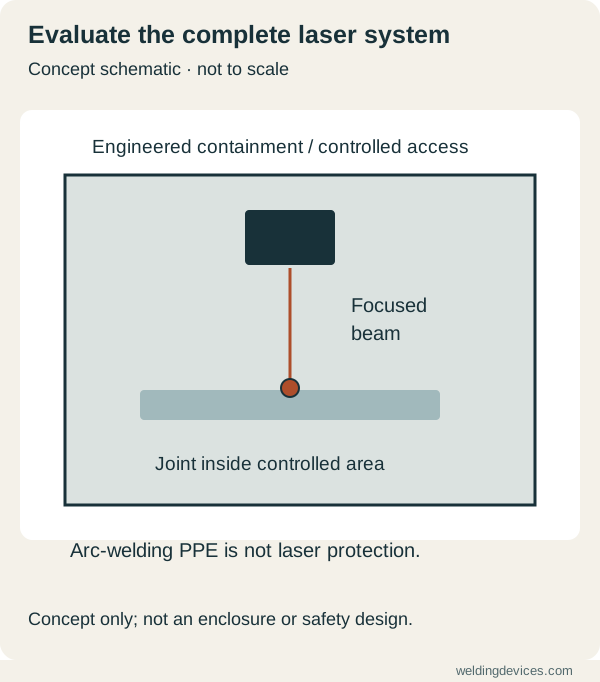
Schematic; source.
Why the complete system matters
Do not compare only the handheld torch with an arc-welding torch. Evaluate the work area, beam containment, access control, extraction, training and inspection needed to use the system properly. These affect cost and whether the process fits the workshop.
The safety difference
High-power welding lasers can create serious hazards from direct and reflected beams, including invisible near-infrared radiation. A standard arc-welding helmet is not sufficient laser protection. A competent laser-safety assessment, suitable enclosure or engineered containment, controlled access and correctly rated protection are essential.
Workshop example
For a repeated thin-sheet joint, ask for a supervised demonstration in a properly controlled laser facility. Supply your actual material and representative fit-up. Examine the joint and discuss its acceptance requirements rather than judging only welding speed.
Compare more than a demonstration video
- Preparation and fit-up tolerances.
- The complete controlled-workspace cost.
- Training, service and maintenance support.
- Suitable inspection and repeatability on your parts.
Laser welding is a specialised process to evaluate, not an unrestricted shortcut for a home workshop. This overview explains the decision; it is not an operating procedure.
Put the application ahead of the demonstration
Begin with an identified material, drawing and acceptance requirement. Ask the supplier to explain which joint designs the proposed system supports and what preparation they require. A fast pass along a carefully fitted sample is useful evidence of one demonstration. It does not establish that your own parts, access and production variation will produce the same result.
Bring representative work to an authorised demonstration facility. Include awkward corners, starts, stops and the largest realistic fit-up variation. Ask how the result will be examined. Record preparation and correction time alongside welding time. A system that performs quickly at the joint can still depend on demanding upstream fabrication. Your assessment needs the work before and after the laser is active.
Treat the work area as part of the system
Ask who designs and validates the protective arrangement for the complete installation. Beam hazards can extend beyond the operator, and a conventional arc-welding helmet is not a general substitute for laser-specific protection. Establish the laser classification, required controls and responsibilities through the manufacturer and a competent laser-safety assessment. Avoid assuming that a handheld format makes industrial safeguards unnecessary.
Include access control, suitable barriers or enclosure, interlocks where applicable, training, extraction and maintenance in the discussion. Ask what changes are required in your premises and how nearby work will be protected. A quotation that lists only the welding unit leaves a substantial part of the decision unanswered. Do not plan informal home experimentation from a marketing video.
Check the practical production chain
List the parts and preparation methods that would feed the proposed process. How consistently can the edges be cut and positioned? Who verifies the joint before welding? What happens when a part falls outside the permitted conditions? The machine's capabilities should fit a controlled fabrication system rather than depend on an operator quietly correcting every inconsistency.
For repeat work, ask how fixtures, cleaning and part identification will be managed. For varied work, ask how configuration changes and operator training are controlled. Include consumables and any filler arrangement in the exact package description. A supplier should be able to connect these answers to the proposed equipment and application, not simply offer broad claims about replacing every other welding process.
Compare evidence from equivalent work
If you are comparing laser with TIG or MIG/MAG, use representative parts and appropriate procedures for each. Record total time, finish requirements, rejected parts and inspection results. Agree which benefit matters: throughput, access, dimensional control or a particular finish. Avoid turning one selected sample into a universal statement about process superiority.
Keep a clear boundary between supplier claims and your observed results. If a claimed saving has not been measured on your work, label it as an assumption. Ask whether an independent or suitably qualified examination is needed. A purchasing report should make uncertainty visible so that the next trial can resolve it, rather than fill the gaps with optimistic arithmetic.
Ask about support before deciding
Find out how training, servicing, protective components and operating documentation will be supplied locally. Ask which maintenance activities the operator may perform and which require authorised service. Review what happens if the system is relocated, the work area changes or a different material is introduced. Those changes may need a fresh assessment and a different controlled setup.
Use the process comparison to keep alternative methods in view. Laser welding can be a valuable industrial capability when the application and installation support it. The useful decision is whether the complete, assessed system delivers an acceptable result for your work. A compact-looking tool or fast demonstration is only the beginning of that investigation.
Put the choice in context.
Try the welding process finder to narrow your equipment research, or compare a complete setup in the ownership cost calculator.
References
Open the publisher’s page. If a new tab fails, use “Open directly” or copy the address into your browser.
- TWI — How laser welding worksOpens the source in a new tabtwi-global.comLink checked · 31 Oct
- ESAB — Laser welding process and safety · sourceOpens the source in a new tabesab.comLink checked · 31 Oct