In this guide
Cover the whole job
Your kit has to work while preparing metal and removing slag as well as while welding. Make a task list before shopping: cutting, grinding, handling hot parts and welding may need different combinations of protection.
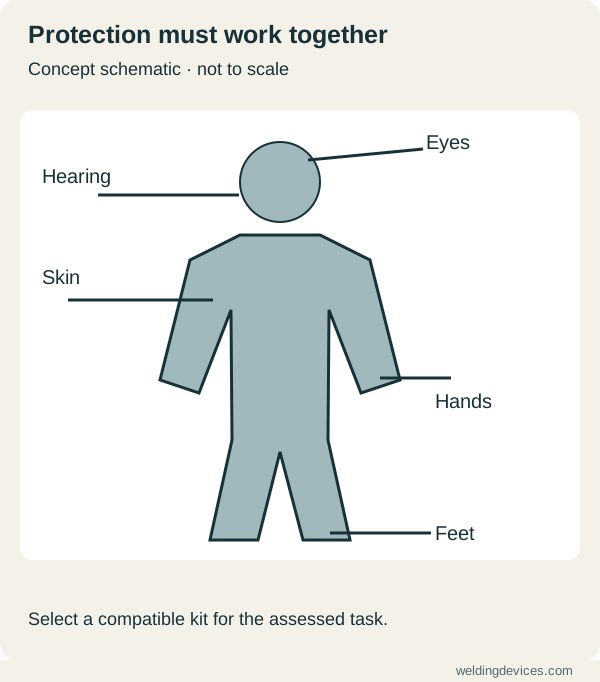
Schematic; source.
Clothing and footwear
Use welding-appropriate flame-resistant clothing and suitable protective footwear. Cover exposed skin and check that sparks cannot collect in cuffs or open pockets. Select garments for the heat and spatter expected, then follow their care instructions.
Eye and face protection
Wear suitable safety glasses beneath the welding helmet. For grinding and slag removal, choose the required impact-rated eye and face protection. A clear face shield does not provide an arc-welding filter, and a welding helmet is not automatically suitable for every grinding task.
Hearing and nearby people
Assess noise from preparation tools and choose compatible hearing protection. Provide suitable welding screens and protect helpers who may be exposed to the arc or flying particles.
Check the combination
Try the glasses, helmet, hearing protection and respiratory equipment together. If one item breaks another item's fit, select a compatible combination. Keep a small inspection routine: clean lenses, check damaged clothing and replace worn protection before the next job.
Map protection to each stage
Write preparation, fitting, welding and cleanup on a short work sheet. Under each stage, list the actual tools and exposures. Grinding can require different eye and face protection from arc welding. Handling edges and removing slag introduce further questions. This task-based list helps you build a suitable combination instead of shopping for one dramatic-looking item and assuming the rest is covered.
Ask a competent supplier to connect each product to its intended use and instructions. Keep the relevant documentation with your equipment record. If a product is advertised for a different task, do not infer welding suitability from its toughness or appearance. Protection should follow the assessed work, including the people nearby, rather than the name printed on a generic workshop kit.
Check coverage while moving
Try the clothing and footwear through the movements needed for the job, with the equipment safely isolated. Bend, reach and adopt the intended working position. Look for gaps at wrists, ankles, neck and waist. Check whether pockets, cuffs or folds could collect sparks. Arrange clothing using the relevant guidance and garment instructions.
Consider how you will enter and leave the work area with the complete kit. A jacket that becomes awkward under helmet headgear or a cuff that pulls away during a reach deserves attention before practice. Select suitable sizes and compatible items rather than making unauthorised alterations. Comfort and mobility help you maintain protection through the whole task.
Understand eye and face roles
Use suitable safety glasses under the welding helmet as instructed. For preparation tasks, establish the required impact protection and whether an appropriate face shield is also needed. A clear shield does not supply the filter needed for an arc. An auto-darkening helmet in grind mode does not automatically establish that every grinding protection requirement is met.
Check lenses and protective covers for damage and clean them using the specified method. Keep replacements available where that is practical. Poor visibility can encourage an operator to lift protection at the wrong moment, so dealing with scratches and dirt is part of maintaining a usable kit. If protection is damaged or unsuitable, correct the issue before continuing.
Include hearing and communication
Assess noise from cutting, grinding and other nearby work, not just the welding process. Choose the required hearing protection with attention to compatibility and correct fit. Ask how instructions, alarms and communication will be managed in the complete setup. The solution should maintain the necessary protection while making the work organisation understandable.
During supervised practice, agree how the instructor will stop the exercise or attract your attention. Keep that method consistent. A noisy workshop can make casual conversation unreliable, especially when several protective items are in use. Clear communication is a practical part of arranging the lesson rather than an optional extra after the equipment has been turned on.
Look after the complete kit
Inspect clothing, footwear, gloves, lenses and hearing protection before work. Follow cleaning, storage and replacement instructions. Keep contaminated or damaged items out of use until they are dealt with appropriately. Store equipment so another task does not cover it in dirt or damage a protective component between sessions.
Use the helmet guide, glove guide and fume-control guide to explore the separate buying decisions. Then try the combination together. A complete kit is useful when it remains correctly fitted through preparation, welding and cleanup. Protect helpers and nearby workers through the job's arrangements as well, rather than concentrating only on the person holding the torch.
Keep a written replacement list with the exact product names and sizes that fitted well together. Review that combination whenever an item changes. A different helmet or jacket may alter the fit, so repeat the movement check before relying on the new kit during work.
Put the choice in context.
Try the welding process finder to narrow your equipment research, or compare a complete setup in the ownership cost calculator.
References
Open the publisher’s page. If a new tab fails, use “Open directly” or copy the address into your browser.
- CCOHS — Welding personal protective equipment and clothing · sourceOpens the source in a new tabccohs.caLink checked · 31 Oct