In this guide
Choose by the task
Welding gloves need to suit the heat, spatter, handling and movement involved. Ordinary gardening gloves are not a substitute for documented welding protection. Start with the manufacturer's intended use and the fit on your hands.
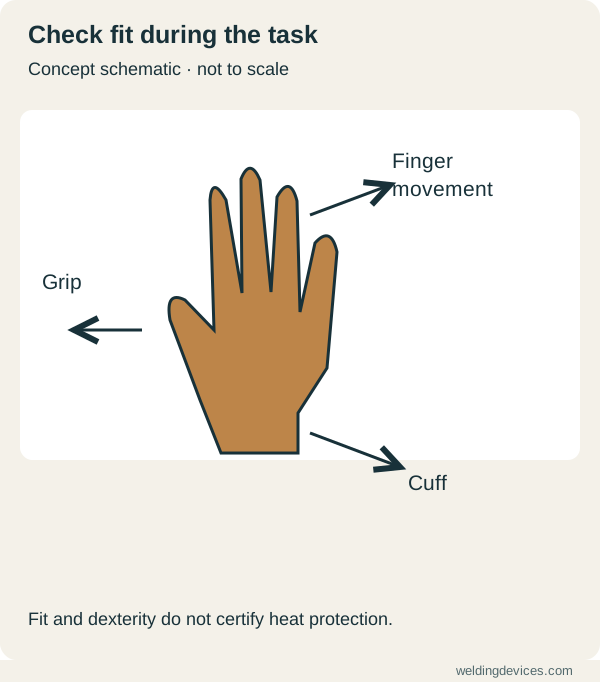
Schematic; source.
MIG/MAG and stick work
These jobs can call for substantial heat and spatter protection. Compare lining, cuff coverage, stitching and durability. Extra material can reduce dexterity, so check whether you can still operate the equipment securely.
TIG work
Feeding filler and controlling a small torch place greater demands on finger movement. A glove sold for TIG may favour dexterity. That does not mean it suits every temperature or heavier-spatter task: check its documented protection and limitations.
Try them with your equipment
With the machine safely isolated, try the controls, torch grip and filler handling. The glove should fit without pulling tight or slipping at the fingertips. Test the jacket cuff arrangement at the same time.
Care is part of the choice
Follow cleaning and replacement instructions. Inspect gloves for holes, damaged seams and contamination. Keep them dry; do not rely on welding gloves as electrical insulating gloves. A second task-appropriate pair can be more useful than one expensive pair expected to do everything.
Match the glove to a whole exercise
Imagine a supervised TIG lesson with small filler additions, then a separate session involving stick welding and slag removal. The movements and exposure differ. Ask the supplier which documented glove type suits each task rather than expecting one heavily padded pair to perform every job equally well. Keep the intended process and handling duties visible during the comparison.
Try the gloves with your jacket, helmet and safely isolated torch. Check how easily you can reach controls, hold the filler and reposition your hands. If the fingers are too long or the palm slides, precise movement becomes harder. If the glove pulls tight when you grip, comfort at rest tells you little about its fit during a full practice exercise.
Understand dexterity as a practical requirement
For TIG, practise feeding a clean practice rod with the equipment isolated. Check whether the glove permits deliberate finger movement without forcing an awkward grip. For MIG/MAG or stick, check secure control of the gun or holder. A glove chosen for fine movement may have different heat and spatter limitations from one selected for heavier work.
Use the manufacturer and supplier's protection information to resolve that trade-off. Thinness alone does not establish quality, and bulk alone does not establish adequate protection. Ask about the intended use and applicable performance information for the exact model. Comfort matters because it supports proper handling, but it cannot replace the documented suitability of the glove for the task.
Look at cuffs and seams
Check how the glove cuff and garment sleeves overlap in the working position. Move your arms as you would during fitting and welding, keeping the equipment isolated. An overlap that looks adequate while standing can shift during a reach. Select a compatible arrangement that maintains coverage without restricting the required movement.
Inspect stitching and the areas that will receive frequent wear. Ask what damage requires replacement and whether cleaning is permitted. Follow the actual care instructions instead of assuming that every leather glove can be washed or treated in the same way. Keep the instructions with the purchase record so that care does not depend on remembering a short explanation given at the counter.
Keep handling tasks separate
Welding gloves are not a general permission to touch hot work, handle every chemical or work on live electrical equipment. Use appropriate tools and protection for each handling task. Plan a clearly identified area for hot parts and use the specified method for moving them. Do not judge a part's temperature from its appearance or from whether the glove initially feels comfortable.
Keep gloves dry and inspect for contamination, damaged seams and holes before use. If one pair becomes unsuitable, stop and replace it with the correct protection. Consider a separate task-appropriate pair for preparation or handling when the assessment calls for it. This avoids carrying debris or contamination from one job into a fine welding exercise.
Buy for maintenance as well as first impressions
Compare replacement availability and consistent sizing alongside the initial price. A workshop may benefit from keeping the same supported glove model available so that an unexpected replacement does not change the fit and handling experience. For an occasional user, clear storage and inspection instructions may matter more than buying several premium pairs at once.
Record what worked during your supervised practice: grip, filler control, cuff movement and comfort. Discuss difficulties with the trainer before blaming the welding machine for every coordination problem. The TIG basics and stick basics lessons help you separate movement practice from equipment choices. Good gloves support the task while meeting its protection requirements; their value comes from that combination.
Put the choice in context.
Try the welding process finder to narrow your equipment research, or compare a complete setup in the ownership cost calculator.
References
Open the publisher’s page. If a new tab fails, use “Open directly” or copy the address into your browser.
- Miller — Choosing welding apparel and gloves · sourceOpens the source in a new tabmillerwelds.comLink checked · 31 Oct