
In this guide
A TIG gas lens changes how shielding gas is distributed inside the cup. A conventional collet body admits gas through holes; a gas lens uses screens to make the outgoing stream more uniform. That can improve coverage, but fitting one does not automatically approve a longer tungsten extension, lower flow or a sound weld. Miller explains the distinction in its manufacturer education.
Reader question: What changes when I replace a TIG collet body with a gas lens?
Learning objective: Distinguish the components and their functions, check a proposed conversion against the correct parts documentation, and plan a supervised comparison without assuming universal settings.
Separate the component names
The collet and the collet body are different items. Miller describes a nozzle and collet used with either a conventional collet body or a gas lens. The nozzle, commonly called the cup, directs shielding gas toward the welding area. A gas lens is therefore part of a torch arrangement, not another name for the cup.
Laminar flow means relatively orderly gas movement. Turbulence means irregular mixing, which can draw surrounding air into the shielding stream. Miller attributes more uniform delivery to the lens screens compared with the holes in a conventional body. These are manufacturer explanations of the mechanism, not measurements from a test performed here.
Compare functions before comparing part numbers
The drawing separates the functions to make the difference visible. It does not show threads, sealing surfaces, assembly order or a complete torch. Use the actual torch's drawing to identify those details; do not assemble equipment from this conceptual comparison.
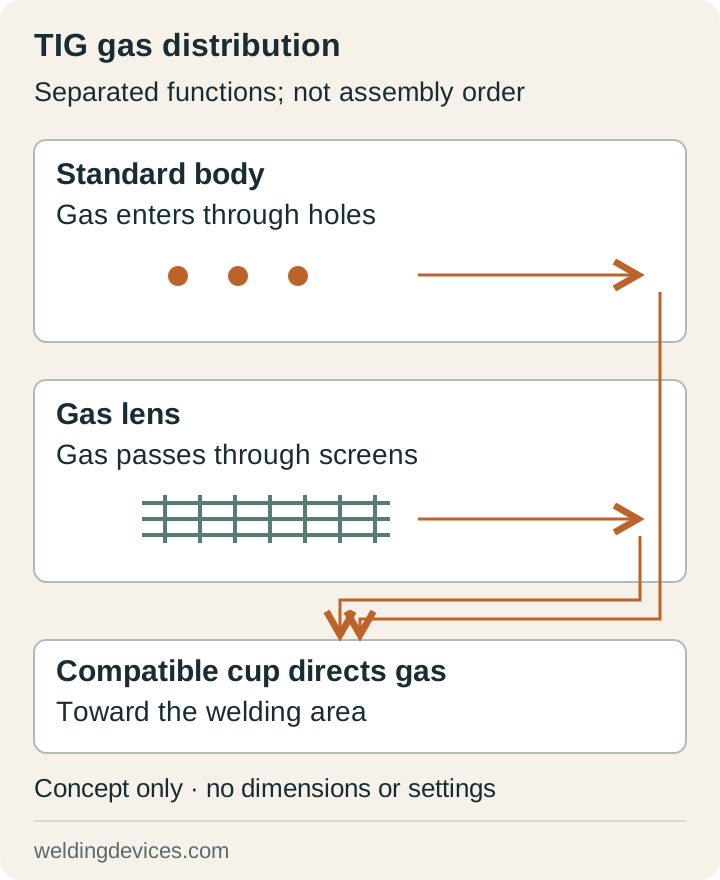
Conceptual gas-path comparison, not to scale or an assembly instruction. Based on Miller's component explanation. Open full-size drawing.
Before buying, make a component list from the documentation. Record the torch model, existing configuration, electrode diameter and the proposed replacement identifiers. Ask the supplier to confirm the complete compatible arrangement, including the cup and any specified insulating parts. A similar-looking thread or familiar cup number does not complete that check.
CK Worldwide's consumables directory separates its 2 Series, 3 Series and other families and lists associated torch models. For example, it lists CK9 and CK20 among 2 Series models, while CK17, CK18 and CK26 appear under 3 Series. These are examples from CK's range, not a cross-brand interchangeability table. The directory provides no basis for treating every gas-lens component as interchangeable.
Keep extension and flow as separate decisions
Tungsten extension is the electrode projecting beyond the cup. A lens can change the available shielding arrangement, but an accessory name cannot determine the permitted extension for an unknown joint. Start with the applicable procedure and equipment instructions. Record what access problem you are trying to solve before changing the configuration.
Likewise, fitting a lens does not establish a new gas-flow setting. Keep the excessive TIG gas-flow lesson beside your setup notes. It explains why simply adding gas can be counterproductive. A comparison becomes difficult to interpret if the cup, extension, flow and hand position all change without a record.
Use a short conversion sheet: existing part, proposed part, documentary match and unresolved question. Leave an entry unresolved when identification is uncertain. That sheet gives a supplier something concrete to verify and prevents a product description from quietly becoming an operating procedure.
Recognise what the lens cannot establish
Coverage near the torch is not automatically protection for every hot surface. TWI's May 1999 titanium welding handbook, printed page 19, discusses gas-lens shielding under favourable joint geometry and the separate role of trailing shields. That is titanium-specific guidance, not a general recipe for every material. It illustrates why the whole joint and shielding requirement matter; no current, speed or purge values from that handbook are adopted here.
Keep exposure controls in the plan. CCOHS calls for adequate ventilation and local exhaust to control welding fumes and gases. Changing torch consumables is not a reason to disable those controls. Follow the workspace safety checks and the equipment's isolation and cooling instructions before inspecting components.
Hypothetical example: reaching a recessed joint
Imagine an instructor plans a practice exercise where access is restricted. A learner proposes a gas lens because holding the existing arrangement comfortably is difficult.
First, they identify the torch and map the complete proposed parts set to its documentation. They then establish the permitted practice configuration and record the cup, extension and gas-delivery instructions. Unknown parts are resolved before assembly.
They label the comparison coupons and record the conditions and observations the instructor asks them to assess. No improved result is assumed. If access remains awkward or shielding is uncertain, they review the arrangement rather than extending the tungsten further by guesswork. An attractive bead does not establish acceptance for a working component.
Checklist and self-check
- Identify the torch and existing consumable family.
- Distinguish the collet, gas-distribution component and cup.
- Verify the complete replacement arrangement against documentation.
- Establish permitted extension and flow separately.
- Retain ventilation, safe maintenance and inspection requirements.
- Record the comparison and unresolved questions.
Self-check: Does a gas lens automatically permit twice the previous tungsten extension?
Answer: No. Screens explain a change in gas distribution, not a universal extension allowance. Check the documented arrangement and applicable procedure before practice.
Put the choice in context.
Try the welding process finder to narrow your equipment research, or compare a complete setup in the ownership cost calculator.
References
Open the publisher’s page. If a new tab fails, use “Open directly” or copy the address into your browser.