
In this guide
Yes. Increasing TIG shielding-gas flow can make protection worse if it creates turbulence that draws surrounding air into the gas stream. Reducing flow indefinitely is not the answer either: inadequate delivery can leave the pool and hot tungsten insufficiently protected. Miller explains both limits in its shielding-gas education.
Reader question: Can increasing TIG gas flow make shielding worse?
Learning objective: Explain why more gas can be counterproductive, identify the information needed before adjusting flow, and plan a documented practice comparison without inventing a universal setting.
Why excessive flow can disturb shielding
TIG, also called GTAW, uses a tungsten electrode and external shielding gas. Laminar flow describes relatively orderly movement; turbulent flow involves irregular mixing. Miller's manufacturer guidance explains that increasing gas velocity can encourage turbulence and air entrainment: surrounding air being pulled into the shielding stream. Cup geometry and the environment also affect delivery.
That mechanism makes “too much argon” a possible explanation, not a diagnosis from bead appearance. TWI lists excessive flow, leaks, draughts and turbulence among causes of porosity, meaning gas cavities trapped as weld metal solidifies. It also identifies contamination and moisture. Investigate competing causes rather than treating every pinhole as proof that flow is high.
Follow the checks before changing the dial
Use the sequence below to organise a discussion with an instructor or equipment supplier. It is an investigation aid, not a flow calculator. If the gas identity, equipment condition or applicable instructions are uncertain, resolve that uncertainty before making another practice weld.
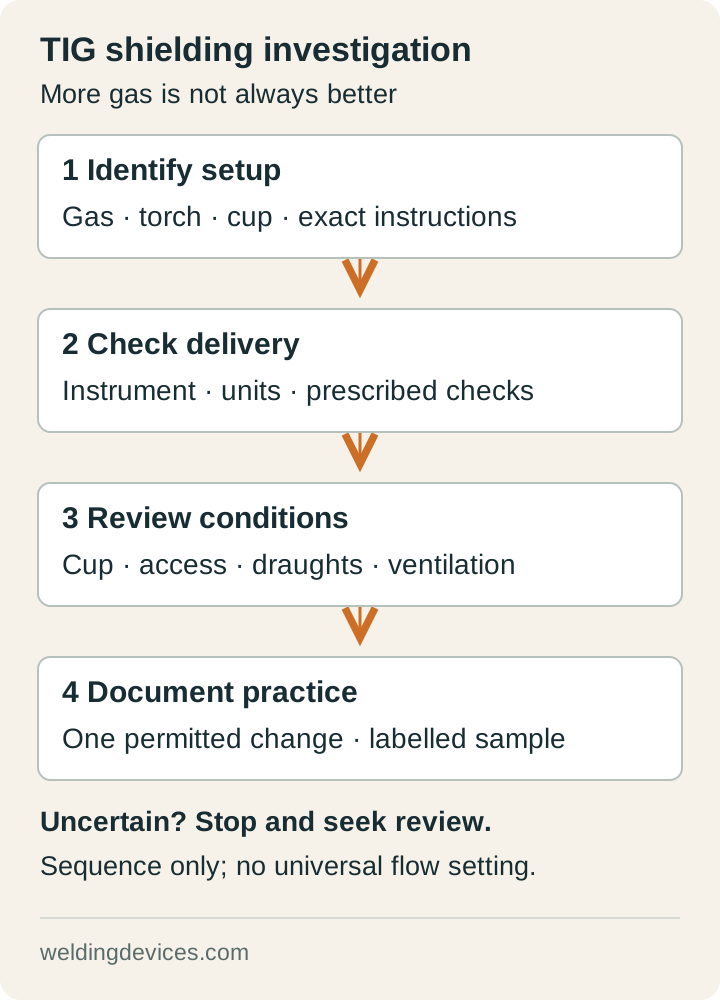
*Investigation sequence; not a gas-flow simulation or setting chart. Shielding principles: Miller and TWI. Open the full-size diagram.*
Start a setup record with the machine model, torch identification, cup, gas and selected procedure. Keep the exact manual beside it. A number copied from another operator is missing the conditions that made it meaningful. Write “unknown” for missing information instead of reconstructing it from memory.
Read the correct instrument and instructions
Gas flow is a volume delivered over time; cylinder pressure is a different quantity. Check the instrument's units and prescribed reading method. CFH means cubic feet per hour, while litres per minute expresses flow in metric units. Never transfer the same numeral between those scales.
For a concrete model-specific reference, section 5-12 of the Multimatic 220 AC/DC manual, OM-281426D shows separate MIG and TIG gas connections and specifies a vertical regulator/flowmeter arrangement. These instructions concern that documented machine revision. They do not establish the connections, orientation or operating range for every welding installation.
Record the units exactly as displayed. If two practice records disagree, first establish whether they describe the same instrument, gas and setup. Do not perform a conversion or adjustment until those identities are clear. Follow the equipment's safe inspection and isolation instructions; suspected leaks require the prescribed response, not an increased flow setting.
Include the cup, access and working area
Miller describes cup size, shape and gas-distribution components as influences on shielding. A flow entry alone therefore cannot describe the whole arrangement. Record which components are actually fitted, and whether reaching the joint changes the intended torch position. This lesson does not select a cup or gas lens for an unknown application.
Keep necessary fume controls effective while addressing draughts. CCOHS warns that shielding gas can displace oxygen and calls for adequate ventilation and exposure controls. Enclosing the work or switching off extraction is not a suitable shortcut. Use the workspace safety checks before practice; confined-space work needs its own competent assessment.
Hypothetical example: the dial was turned up
Imagine a supervised TIG exercise on identified practice coupons. After seeing pinholes, a learner increases flow without recording the original value. The next sample still has holes. Neither observation establishes the cause.
The instructor stops the comparison and reconstructs only facts that can be checked: equipment identification, instrument units, cup, gas and recent changes. The missing baseline stays marked “not recorded.” They review delivery, preparation and the working area against the applicable instructions.
Once those checks support a permitted practice setup, they label a fresh coupon and record one agreed change. They compare the specified observations without predicting success. Persistent holes or uncertain findings require further assessment. The porosity investigation guide provides the broader fault log; this example supplies no production setting or acceptance decision.
Checklist and self-check
- Identify gas, torch, cup, machine and applicable instructions.
- Record the instrument, units and documented baseline.
- Review delivery and equipment condition through the prescribed checks.
- Consider preparation, access and draughts without disabling exposure controls.
- Record one permitted practice change and retain labelled observations.
- Stop for qualified review when the cause or joint acceptance remains uncertain.
Self-check: Pinholes remain after increasing flow. Does that prove the cylinder needs replacing?
Answer: No. Excess flow is one possible contributor, alongside leaks, draughts and contamination. Verify the setup and competing causes before another adjustment. A better-looking surface alone does not prove a weld fit for service.
Put the choice in context.
Try the welding process finder to narrow your equipment research, or compare a complete setup in the ownership cost calculator.
References
Open the publisher’s page. If a new tab fails, use “Open directly” or copy the address into your browser.