
In this guide
Reader question: What should I compare before choosing 6011 or 6013 welding rods?
Compare the exact manufacturer's product, diameter, supported electrical output and intended application before choosing. The classification is a starting point for a lookup, not a complete purchase specification or permission to copy another welder's settings. Keep the package identity beside the machine instructions so that both sides of the proposed setup can be checked.
Learning objective: Build a useful comparison of two named electrodes, distinguish product claims from general rules and identify missing information before a supervised practice session.
Start with two identified products
Write down each manufacturer's name, full product designation and package code. Photograph the label if that helps preserve the information, but make sure the text remains readable. Record the diameter separately from the classification. Two packets can belong to the same classification while requiring their own documented checks.
For a concrete example, Lincoln Electric's retail page identifies Fleetweld 180-RSP as E6011 and Fleetweld 37-RSP as E6013. Lincoln describes the former for small AC machines, including a stated low open-circuit-voltage capability, and presents the latter for sheet-metal work where appearance matters. These are manufacturer descriptions of those products, not independent tests or promises about every 6011 or 6013 electrode.
Do not turn that short comparison into “one always wins.” A useful selection explains which requirement a documented product satisfies. It also leaves unanswered questions visible instead of filling them with assumptions about an entire electrode family.
Separate output type from operating current
AC means alternating current. DC means direct current; the specified electrode polarity also matters when the equipment uses DC. Open-circuit voltage, often abbreviated OCV, describes voltage before an arc is established. It is not the same quantity as welding current. A large current number on a machine's front panel does not answer every compatibility question.
Miller's stick-welding education directs readers to the selected electrode's output requirements and the manufacturer's operating information. Use the package and applicable data sheet together with the exact machine manual. If the required information is absent, ask the supplier or manufacturer before deciding that the combination is supported.
Avoid importing a numerical setting from a different diameter, position or product. This lesson supplies no universal amperage, arc-length dimension or penetration comparison. Those would require evidence applicable to the actual exercise.
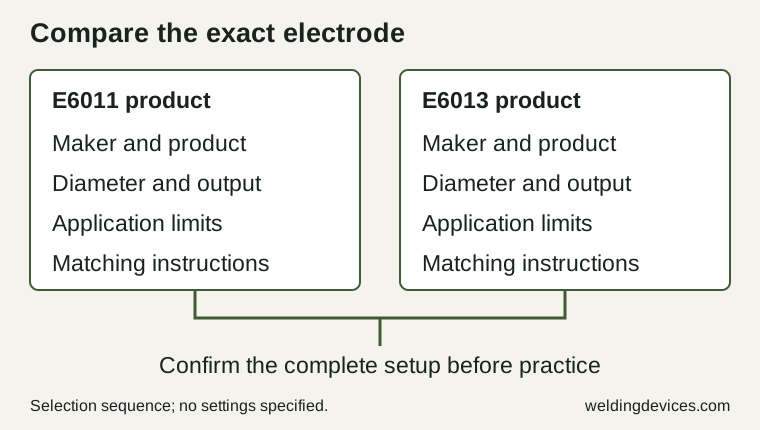
Selection sequence, not an arc or weld cross-section. The matching fields organise the manufacturer-document checks above; the boxes do not imply equivalent performance. Open the drawing.
Compare the application before the demonstration
Define the proposed practice task in ordinary language: identified material, joint, position and purpose. Then place the manufacturer's application statements beside it. A phrase such as “sheet metal” is useful context, but it does not establish a procedure for every thickness, coating or service condition.
Keep preparation in the comparison. Miller's cited guidance calls for cleaning the work and establishing a sound work connection. Do not interpret a forgiving electrode description as an instruction to weld over unidentified contamination. If the material or coating is uncertain, resolve that uncertainty before choosing the practice exercise.
Use our stick-welding lesson to organise supervised movement practice after the setup is confirmed. The lesson and a consumable selection page serve different purposes: one structures learning, while the other helps identify the product to investigate.
Hypothetical example: compare without guessing
Imagine a beginner bringing two labelled packets to an instructor: Fleetweld 180-RSP and Fleetweld 37-RSP. The planned session uses identified practice material and an AC machine. No welding has been performed yet.
The beginner creates two columns. Each contains the classification, diameter, exact package identity, relevant manufacturer statement and the machine-document reference. Lincoln's description gives one product a specifically stated small-AC-machine claim. That does not prove the other packet unsuitable; the next step is to find its applicable output information rather than infer an answer from the shorter webpage description.
The instructor checks the complete proposed arrangement and selects an appropriate exercise. Any missing entry remains a question. This example demonstrates a decision process, not a successful test, a recommended product or a machine setting.
Keep electrical safety attached to the choice
CCOHS electrical-safety guidance warns that touching live welding-circuit components can be fatal. Follow the exact equipment instructions for shutdown, isolation and handling; do not inspect connections as though a live welding circuit were harmless.
Our workspace safety guide helps identify the surrounding protection and exposure-control questions. A packet selection cannot establish that a structural repair or other critical weld is suitable for service.
Practical checklist and self-check
Before choosing either packet:
- Identify manufacturer, product, classification and diameter.
- Read the applicable output and polarity requirements.
- Match the machine's documented capabilities.
- Check the intended material, preparation and practice task.
- Record unresolved questions and obtain suitable guidance.
Self-check: Does an E6013 label alone prove compatibility with an AC machine?
Answer: No. Confirm the exact product's instructions and the machine's supported arrangement. A classification starts the investigation; it does not finish it.
Put the choice in context.
Try the welding process finder to narrow your equipment research, or compare a complete setup in the ownership cost calculator.
References
Open the publisher’s page. If a new tab fails, open “Link options” to use the current tab or copy the address.
- Lincoln Electric — Fleetweld 180-RSP and 37-RSP retail descriptions (undated) · Lincoln Electric's retail pageOpens the source in a new tablincolnelectricretail.comCheck inconclusive · 5 Nov
One vote per browser. Select again to remove it. Privacy