
In this guide
Reader question: Must the contact-tip bore match the welding-wire diameter?
Choose the contact tip specified for your wire’s nominal size, material and gun system. A wire-size label tells you which consumable to select; it is not a drilling dimension. Check the manufacturer’s part table rather than choosing a larger hole to cure feeding trouble. Lincoln Electric’s selection guide says tip-size labels should match the wire.
Learning objective: Identify the wire-size designation, check gun compatibility and explain why a tip that looks right may still be the wrong replacement.
Understand what the contact tip does
The bore is the passage through the tip. Nominal diameter is the wire size used to identify the product, such as the size printed on its spool. Read that label before opening a packet of tips.
In MIG/MAG welding, also called GMAW, wire travels continuously through the torch; shielding gas protects the welding zone. MIG and MAG differ in the shielding gas used. TWI explains this process and wire path.
The tip transfers current into the moving wire. It must maintain electrical contact while allowing wire to travel. Bernard and Tregaskiss describe these competing requirements. The surrounding gas nozzle is a separate component; ordering a nozzle by its opening size does not identify the contact tip inside it.
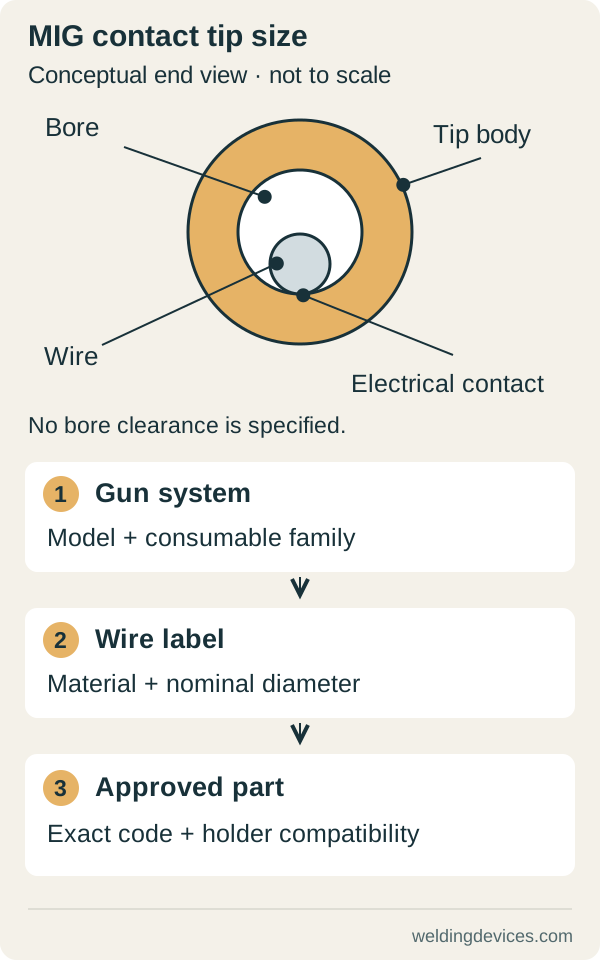
Conceptual end view and selection sequence; not to scale. No bore clearance is specified. Open the drawing. Basis: the contact function described above and the manufacturer compatibility checks below.
Check the gun system before the size number
Write down the gun model and consumable family. Then check its current parts list for the wire material and diameter. Matching a size number alone does not establish MIG contact tip compatibility.
Bernard’s compatibility chart separates gun families, marks limitations and identifies cases needing special parts. Some entries also depend on manufacture date. It is guidance for the listed Bernard systems, not a cross-brand interchangeability chart. Bernard and Tregaskiss share ITW ownership; their guidance is one manufacturer group’s evidence.
Keep the full part number when ordering. Ask the supplier to confirm the tip, holder or diffuser combination against your gun’s documentation, rather than accepting “same diameter” as the entire compatibility check.
Avoid an improvised oversized or undersized tip
Bernard and Tregaskiss warn that an oversized contact tip can impair current transfer, while an undersized one can add friction and contribute to erratic feeding or burnback. Burnback means wire fusing in or onto the tip.
Their guidance discusses undersizing for certain drum-fed or solid-wire arrangements. That manufacturer-specific discussion is not a universal workshop adjustment. Obtain an approved recommendation for your actual setup before departing from its normal selection table.
A different tip cannot resolve every feed fault. The Fronius manual for MTG/MTW/MTB/MHP 250d–700d torches lists several causes of short tip life, including wrong tip dimensions, roller problems and an overheated loose tip. If feeding remains unreliable, follow our wire-feed troubleshooting guide to examine the wider path.
Worked example: one wire size, different part numbers
Imagine a supervised practice setup whose documentation has already confirmed Lincoln’s Magnum PRO 350A standard-tip family. The installed wire is .035-inch steel. On page 35 of Lincoln’s selection guide, the relevant steel entry is KP2744-035; the same wire-size row lists KP2744-035A for aluminium.
This hypothetical lookup shows why diameter alone is insufficient. It does not establish compatibility with another gun family. “350A” identifies the table’s consumable class here; it is not a welding-current recommendation. No welding settings or test result are implied.
If the next exercise uses aluminium of the same nominal diameter, repeat the selection rather than reusing the steel entry automatically. This lookup does not approve the machine, liner or feeding arrangement for aluminium; those require their own documented checks.
Before ordering, record the gun identity, wire designation and complete selected part number together. That small record makes the next replacement easier to check.
Replace consumables using the permitted procedure
Do not inspect a tip while it is electrically live or hot. CCOHS explains the danger of contact with live welding circuits. Follow your equipment’s shutdown, isolation, cooling and replacement instructions. Fronius’s cited manual requires trained personnel, disconnection and protection against restarting before its described work. Its specific fitting details must not be transferred to another torch.
For the surrounding components, read our torch and consumables guide.
Practical checklist and self-check
Before buying or fitting a replacement:
- Read the installed wire’s material and nominal diameter.
- Confirm the gun model, consumable family and applicable document revision.
- Find the exact approved tip entry, including any material suffix.
- Check the holder or diffuser compatibility and required installation method.
- Record the parts used; investigate recurring faults instead of repeatedly changing size.
Self-check: Two tips carry the same wire-size marking. Does that prove either will suit your gun?
Answer: No. Confirm the consumable family, wire material and complete approved part number. The diameter marking answers only part of the selection question.
Put the choice in context.
Try the welding process finder to narrow your equipment research, or compare a complete setup in the ownership cost calculator.
References
Open the publisher’s page. If a new tab fails, use “Open directly” or copy the address into your browser.
- Lincoln Electric — Magnum PRO Selection Guide, MC22-98 (06/23), pp. 7, 35 and 40 · Lincoln Electric’s selection guide · page 35 of Lincoln’s selection guideOpens the source in a new tabch-delivery.lincolnelectric.comLink checked · 4 Nov
- Bernard and Tregaskiss / ITW — Gun Series Compatibility with Consumables and Liners · Bernard’s compatibility chartOpens the source in a new tabbernardtregaskiss.comLink checked · 4 Nov