
In this guide
Understand what changes during the bead
Stick welding uses a flux-coated consumable electrode. The electrode becomes shorter as welding progresses, so your movement must maintain the supported arc while also advancing along the joint. Flux provides protection and leaves slag that needs the appropriate removal between operations. That combination gives beginners several separate skills to practise.
Use identified practice material, a selected compatible electrode and an instructor's documented setup. Follow the equipment, electrode, protection and exposure-control instructions. This lesson provides a learning sequence. It does not qualify repairs or replace procedures and inspection required for structural, pressure-containing, vehicle or lifting applications.
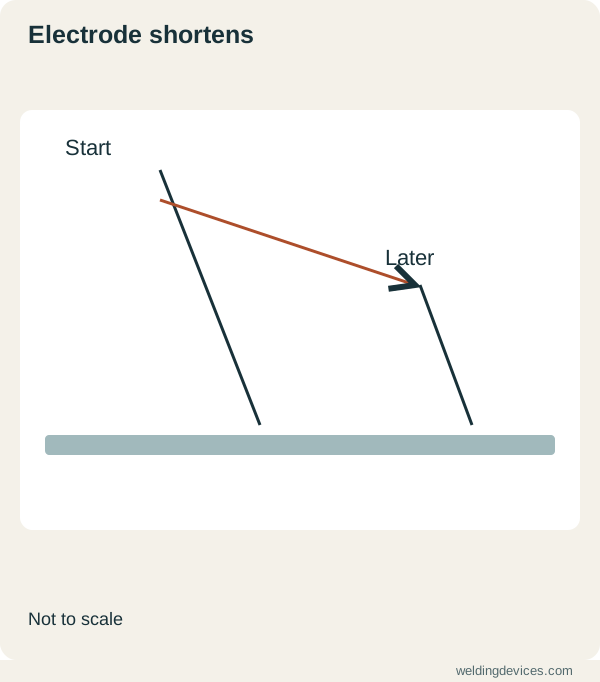
Schematic; source.
Read the electrode instructions
Record the exact designation, diameter, permitted positions, current and polarity requirements. Review storage and handling. Electrode appearance or a familiar brand does not identify every operating requirement. A setting copied from another electrode may be an unsuitable starting point even when the two rods look similar.
For low-hydrogen electrodes, storage condition is part of the controlled setup. TWI notes that basic-electrode coatings can take up atmospheric moisture rapidly, while Hobart Brothers advises protecting sealed packaging and holding opened rods at the exact product maker’s specified temperature. If the opening time or storage history is unknown, separate the rods until the product instructions, welding procedure and applicable job requirements determine the next action. The low-hydrogen electrode storage lesson explains holding, redrying and exposure records without inventing a universal oven cycle.
Confirm that the machine and holder support the selected arrangement. Check accessible leads and the work connection as instructed. Have electrical supply questions assessed competently. Keep the chosen electrode packet and its technical information near the practice record so that the setup can be repeated without relying on memory.
Rehearse the shortening electrode
With the machine safely isolated, practise holding the electrode in the selected position and moving along the planned path. Imagine the tip becoming shorter during the movement. Your hand must accommodate that change without losing the required joint angle. Ask the instructor to check the rehearsal before starting.
Arrange a stance and suitable support that allow a short exercise to be completed comfortably. Keep the holder, lead and clothing from interfering with the movement. Establish the hot-part area and safe handling of used electrodes. Planning a short repeatable exercise is more useful than attempting a long bead until fatigue or poor access takes over.
Practise an authorised arc start
Your instructor should demonstrate the supported starting method on practice material, with the required protection and controls. Follow that method and the correct response if the electrode sticks. Keep the holder and accessible live parts within the equipment's safety instructions. Do not grab the electrode to free it or improvise an electrical workaround.
Treat starting as its own exercise. Label the sample and note whether the start was controlled, whether the electrode stuck and whether the operating setup was confirmed. Discuss the observation before changing several settings. Arc-start practice can reveal movement and configuration questions that would otherwise become hidden inside a longer weld.
Maintain a controlled arc
Miller's introductory advice describes a short arc referenced to the electrode's metal core diameter, while emphasising that the correct length depends on the electrode and application. Use your instructor's and procedure's requirements for the actual exercise. Avoid lifting progressively farther away as the electrode shortens.
Move at a deliberate pace and watch the weld region rather than following only the most visible slag. Start with the prescribed straight movement. A wide weave introduces another variable and should have a specific purpose within the selected procedure. Record where the arc became inconsistent or your angle changed so the next trial can address that event.
If the arc repeatedly pulls away from the intended line, record where it happens and the current-return position before changing several settings. TWI describes magnetic arc blow as deflection caused by a distorted magnetic field; residual magnetism and return position can contribute. This observation needs investigation rather than an automatic increase in current. Read the magnetic arc blow lesson for a labelled, supervised comparison, with the mechanism explained by TWI.
Remove slag and inspect properly
After the prescribed cooling and safe handling, remove slag with the appropriate tools and eye and face protection. Inspect the complete bead, including its edges, beginning and end. Follow the procedure's cleaning requirements before another pass or restart. Covering an uncertain result with more weld metal does not establish acceptability.
Record bead consistency, visible discontinuities and what happened during the exercise. Ask the instructor to explain which observations suggest another check. Visual appearance cannot by itself prove internal fusion or strength. Keep the sample labelled so a useful comparison remains available after the next practice bead.
Give restarts their own lesson
When the instructor selects a restart exercise, use the specified preparation and sequence. Rehearse where the electrode will begin and how the movement will continue. Inspect the restart area rather than judging only the uninterrupted middle of the weld. Record any change in stance or access around that point.
Keep restarts on planned practice material until the skill is repeatable under supervision. Avoid moving immediately to difficult positions because a flat coupon looked satisfactory. Position, joint and electrode requirements can change the technique, and progression should follow an appropriate training plan.
Choose the next skill from your record
Keep the electrode information, machine setup, coupon description and instructor's comments together. Choose one next objective: a steadier short arc, a more controlled start, better movement or improved joint preparation. Repeat a comparable sample before introducing another variable.
Use the joint preparation lesson and technique lesson to extend your practice. Stick welding becomes easier to understand when the start, shortening electrode, travel and slag removal are learned deliberately. A useful session leaves clear observations and a repeatable next step.
Check the surface before another pass
Use the between-pass slag removal lesson to organise a cleaning checkpoint, record uncertain residue and distinguish an accessible surface from material enclosed in earlier layers.
Put the choice in context.
Try the welding process finder to narrow your equipment research, or compare a complete setup in the ownership cost calculator.
References
Open the publisher’s page. If a new tab fails, use “Open directly” or copy the address into your browser.
- Miller — Five steps to improving stick technique · sourceOpens the source in a new tabmillerwelds.comLink checked · 31 Oct
- HSE — Welding exposure controlsOpens the source in a new tabhse.gov.ukLink checked · 31 Oct
- TWI — Welding consumables: Part 2Opens the source in a new tabtwi-global.comLink checked · 31 Oct
- Hobart Brothers — Gaining Benefits with Low Hydrogen Filler MetalsOpens the source in a new tabhobartbrothers.comLink checked · 31 Oct
- TWI — What is magnetic arc blow? · TWIOpens the source in a new tabtwi-global.comLink checked · 31 Oct