
In this guide
Can a tidy bead still have lack of fusion?
Yes. Depositing weld metal and achieving fusion are different things. Lack of fusion means that deposited metal has not properly united with a joint face or an earlier weld run. A smooth outer surface cannot establish what happened underneath. This lesson answers one question: what should you investigate before changing settings when you suspect lack of fusion?
Learning objective: distinguish the location of possible incomplete fusion, organise useful setup observations and recognise when inspection or procedure review is needed.
Understand the hidden interface
The parent metal is the material being joined. A sidewall is a prepared joint face; an inter-run interface lies between successive weld deposits. Fusion requires the relevant surfaces to melt and unite during welding. The amount of metal visible above the joint does not, by itself, demonstrate that union. TWI's identification guidance distinguishes sidewall and inter-run fusion imperfections.
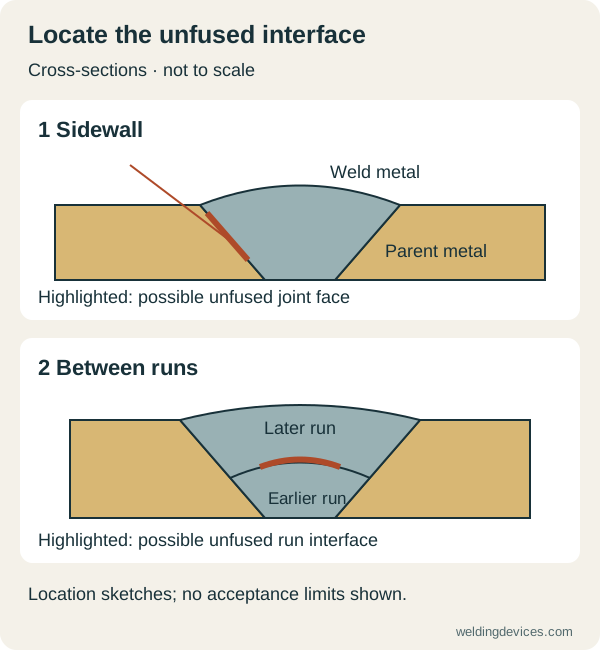
Conceptual cross-sections, not to scale. Highlighted lines indicate possible unfused interfaces, not measured gaps. Shapes teach locations rather than acceptance criteria; based on TWI Job Knowledge 41.
Use precise notes: “suspect indication beside the left joint face” is more useful than “bad weld”. Keep observations separate from conclusions. A photograph can record a surface feature, but it cannot supply an internal cross-section.
Investigate access before chasing heat
Start with the drawing and welding procedure specification, or WPS: the document defining the permitted welding method and conditions for that job. Confirm that the actual preparation and torch access match the instructions. A tight opening or obstructing feature can make it difficult to direct the arc where needed. Surface contamination is another investigation point. TWI's cause analysis links restricted access, preparation, parameters and technique with fusion problems.
Do not widen a production joint or invent a weaving pattern simply because a general article mentions it. Record the mismatch and ask the responsible instructor or welding coordinator to resolve it. On a training coupon, an isolated, unpowered rehearsal can help reveal whether your hand position loses access partway along the joint.
For the preparation stage, use our joint preparation and inspection manual. For successive runs, use the between-pass cleaning checkpoint. These checks support repeatability; neither certifies an internal bond.
Why faster and slower can both be wrong
Travel speed is movement along the joint. It must be considered with the selected process and permitted settings, rather than treated as a separate cure. SSAB lists both excessive and insufficient speed among possible causes in its lack-of-fusion guidance. Its explanation of slow travel includes metal moving ahead of the arc. That page expressly applies to original SSAB products and professional users; its action list is not a universal setting recipe.
Miller's rework guidance also describes operators alternately falling behind the pool and rushing ahead. The manufacturer connects technique, parameters and wire feeding with weld quality. Those observations help frame questions; they do not establish a suitable voltage, wire speed or transfer mode for your machine. This lesson adopts no numerical settings or advertised productivity claims.
Write down the initial setup before any authorised trial. Otherwise, several simultaneous changes can leave you unable to explain which difference mattered.
Hypothetical worked example: a practice joint
Imagine a learner making labelled, non-service practice coupons under supervision. One coupon has a consistent outer bead, but the instructor suspects incomplete fusion. The learner's first suggestion is to increase output.
Instead, they label the coupon A, retain the settings record and sketch the suspect location. They compare the preparation with the exercise instructions, check whether access changes along the joint, and review cleaning and travel observations. They do not assume that a neat section at one end represents the whole length.
The instructor decides whether a further coupon, a sectioning exercise or another examination is appropriate. If another trial is authorised, they record its specific change as coupon B. No improved result is assumed here: this example demonstrates a controlled investigation, not a tested repair or a pass verdict.
Practical investigation checklist
- Identify the material, joint, process and applicable instructions.
- Record the suspect location and the observation that raised concern.
- Compare preparation, cleanliness and physical access with the procedure.
- Record consumable identity, settings and any feeding irregularity.
- Review movement and position with a competent instructor.
- Keep labelled samples and notes for any authorised comparison.
- Obtain an inspection decision before accepting or repairing the work.
Self-check: does appearance settle the question?
A coupon looks smoother after a setting change. Does that prove that the earlier fusion problem has disappeared?
Answer: no. Appearance is one observation. The required examination and acceptance decision still depend on the job. TWI describes different methods for surface-breaking and buried imperfections; selecting them requires the relevant inspection expertise. Do not grind away the evidence or cover a suspected problem with another pass before assessment.
Sources checked 29 October 2026. TWI's article originated in May/June 1999 and was subsequently updated without a stated update date; its historical acceptance table is not used here. SSAB shows no publication date. Miller's article is dated 27 May 2024. This lesson explains investigation, not qualification or acceptance of service welds.
Put the choice in context.
Try the welding process finder to narrow your equipment research, or compare a complete setup in the ownership cost calculator.
References
Open the publisher’s page. If a new tab fails, use “Open directly” or copy the address into your browser.
- Miller — reduce weld rework, 27 May 2024; checked 29 October 2026 · Miller's rework guidanceOpens the source in a new tabmillerwelds.comLink checked · 31 Oct