
In this guide
Reader question: How should you store low-hydrogen stick electrodes after opening, and can exposed rods be used again?
Learning objective: After this lesson, you can explain why the coating must stay dry, separate holding from redrying, and decide when the product instructions or welding procedure must control the answer.
Direct answer: Keep unopened electrodes in their intact moisture-resistant package. Once opened, move low-hydrogen electrodes into the holding conditions specified by their manufacturer and your welding procedure. If their exposure history is unknown or exceeds the permitted limit, quarantine them; do not guess a redrying cycle. Reuse is acceptable only when the exact electrode instructions and applicable code or procedure allow it.
“Low hydrogen” depends on a controlled condition
A low-hydrogen electrode is designed to limit the diffusible hydrogen introduced into deposited weld metal. The name does not mean that every rod remains low hydrogen after careless storage. The flux coating can absorb moisture from the atmosphere, and that moisture can become a hydrogen source during welding.
TWI explains that basic, or low-hydrogen, electrode coatings contain little or no moisture when handled correctly, but can pick up moisture rapidly in air. It also says baking and subsequent warm storage must follow the manufacturer’s recommendations (TWI, *Welding consumables – Part 2*).
This matters because hydrogen, a crack-sensitive microstructure and tensile stress can combine to produce hydrogen-assisted cracking. Steel strength, thickness, restraint and temperature affect that risk. A dry-looking coating is therefore not proof that an electrode still meets the required hydrogen condition.
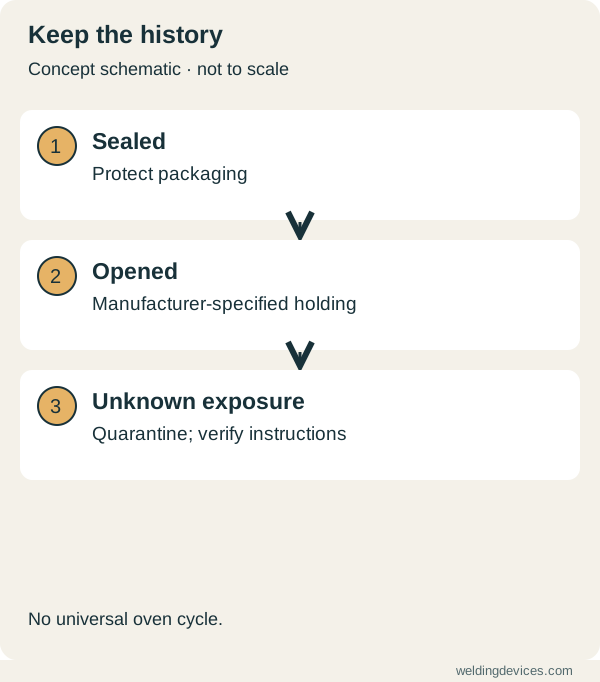
Schematic; source.
Read the markings without overpromising
An H designator reports a tested diffusible-hydrogen level for deposited weld metal under the applicable test conditions. CWB’s explanation of the test says the measured result is expressed in millilitres per 100 grams of deposited metal; for example, a measured result can lead to an H8 designator (CWB Group, *Testing for the Hydrogen Content of Welding Consumables*). The designator describes a classification test, not permission to ignore storage instructions.
Some covered electrodes also carry an R suffix. Hobart Brothers describes this as an additional moisture-resistance designation verified by a defined exposure test. The same manufacturer article still instructs users to protect sealed packaging, use clean gloves and hold opened low-hydrogen SMAW electrodes at the filler-metal manufacturer’s recommended temperature (Hobart Brothers, *Gaining Benefits with Low Hydrogen Filler Metals*). In other words, moisture resistance extends a tested capability; it does not make the coating moisture-proof.
A hermetically sealed pack is an unopened package intended to prevent moisture entry. Once its seal is broken, the exposure clock and storage rules for that exact product begin. Do not transfer an exposure time, holding temperature or redrying cycle from a different brand, classification or package type.
Holding is not the same as redrying
A holding oven keeps electrodes that are already in an acceptable condition from taking up more moisture. Redrying is a corrective heat cycle intended to remove absorbed moisture. They are different jobs.
The correct action comes from four documents or records:
- The exact electrode manufacturer’s data sheet or package instructions.
- The welding procedure specification, when one applies.
- The governing fabrication code or contract requirement.
- A shop record showing when the package was opened and how the rods were stored.
If any of those sets a stricter limit, follow it. Manufacturers may limit exposure time, redrying temperature, duration or the number of permitted redrying cycles. High heat can also damage some coatings, so “hotter and longer” is not a safe rule.
For an introduction to electrode handling within the wider process, use the stick welding practice lesson. If the symptom you are investigating is pinholes rather than an unknown exposure record, start with the separate porosity troubleshooting guide.
Hypothetical worked example: the unlabelled container
Imagine a supervisor finds half a pack of E7018 electrodes in an unheated cabinet on Monday morning. The container has no opening date, and nobody can confirm whether the rods were kept in a holding oven. The work drawing calls for a controlled low-hydrogen procedure.
The wrong shortcut is to inspect the coating, decide it looks dry and return the rods to production. Appearance cannot reconstruct time, humidity or temperature.
A defensible sequence is to label and quarantine the rods, identify the manufacturer and exact product, then compare the product instructions with the welding procedure and job code. If those documents permit a specific reconditioning cycle and the shop has suitable controlled equipment and records, the responsible person can follow that route. If the history or permitted treatment cannot be established, the rods should not be used for that controlled work. Opening a fresh compliant pack protects traceability; it does not prove the quarantined rods are unusable for every possible noncritical task.
An opening-time label prevents a later visual guess from becoming a welding decision.
Practical low-hydrogen electrode checklist
- Confirm the exact classification, suffixes, manufacturer and product name.
- Keep unopened packaging intact and dry until needed.
- Record the package opening date and time.
- Transfer opened rods to the manufacturer-specified holding condition promptly.
- Keep mixed products and unidentified stubs out of the controlled container.
- Use clean, dry gloves when handling electrodes.
- Record time outside controlled storage where the procedure requires it.
- Quarantine rods with unknown history, damaged coating or wet packaging.
- Redry only when the exact product instructions and job requirements permit it.
- For structural, pressure, lifting or other critical work, use the approved welding procedure and responsible welding personnel rather than a general web guide.
Self-check
Question: A rod is marked H4R and looks dry after sitting on a bench. Does that alone prove it can return to a code-controlled job?
Answer: No. H4 reports a tested hydrogen classification and R reports tested moisture resistance under defined conditions. Neither replaces the manufacturer’s exposure limits, the welding procedure, the governing code or a reliable storage record.
Put the choice in context.
Try the welding process finder to narrow your equipment research, or compare a complete setup in the ownership cost calculator.
References
Open the publisher’s page. If a new tab fails, use “Open directly” or copy the address into your browser.
- TWI — Welding consumables: Part 2 · TWI, *Welding consumables – Part 2* · sourceOpens the source in a new tabtwi-global.comLink checked · 31 Oct