
In this guide
A stick-welding arc that bends away from the intended weld line may be experiencing magnetic arc blow. Stop and investigate the pattern before changing several settings. TWI identifies distortion of the arc's magnetic field as the mechanism; current-return position and residual magnetism are possible contributors. An erratic bead alone does not identify the cause. TWI: magnetic arc blow.
Reader question: Why does my DC stick-welding arc pull away from the joint?
Learning objective: Explain magnetic arc blow, distinguish observations from a diagnosis, and plan a supervised investigation without inventing settings.
What magnetic arc blow means
Stick welding is also called MMA or SMAW. DC means direct current. The current return is the work lead that completes the welding circuit through the workpiece. Record its position separately from the electrode holder's position.
TWI describes how the magnetic field associated with current flowing through the plate can interact with the field around the arc. Magnetic handling can leave residual magnetism in steel. Uncontrolled deflection can contribute to lack of fusion: the weld has failed to join adequately to the intended surface. These are reasons to investigate a persistent directional pull rather than keep covering it with metal. TWI explanation.
For the underlying movement skills, revisit the stick-welding practice lesson. Keep this troubleshooting exercise separate from learning a new electrode or position.
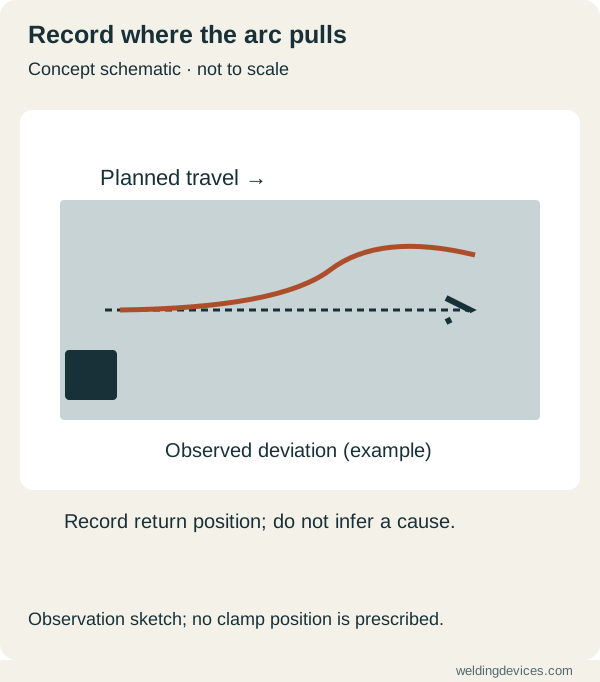
Schematic; source.
Describe the event before choosing a remedy
Make a simple sketch with arrows for travel direction and observed arc deflection. Mark the clamp, start, finish and location where the behaviour changes. Write “pulls towards the start near the finish” rather than “bad welding”.
Treat the sketch as an observation record. Do not label the material magnetised just because the arc wandered once. Ask an instructor to review whether the electrode movement and documented setup were consistent. Recording what stayed constant makes the next comparison easier to interpret.
TWI's prevention guidance particularly associates arc blow with residual magnetism and DC welding, including root runs. The root run is the first weld pass at the joint root. Its guidance is general troubleshooting information, not a parameter sheet for your machine or electrode. TWI prevention guidance.
Understand what moving the return can change
Changing the return connection changes the current path through the work. Steel producer SSAB explains that this can oppose the field causing deflection, but says the effect is limited and may need other measures. Its recommendations explicitly apply to SSAB products and professional users; they are manufacturer guidance, not an independently tested cure for every steel. SSAB: workpiece connections.
That limitation matters when reading advice to move a clamp “forward” or “back”. Those words require a stated travel direction and observed deflection. Discuss the actual sketch and approved arrangement with the instructor instead of following an isolated diagram from a different joint.
Keep electrical checks within the instructions
Before starting, confirm the work connection and accessible leads as the equipment instructions require. The US OSHA arc-welding rule requires a firmly attached work lead and proper connections. It also distinguishes machine-frame grounding requirements from the work-lead connection. Treat it as a US workplace reference; local requirements still apply. Follow the manufacturer's shutdown instructions before rearranging connections. OSHA 1910.254.
TWI lists maintaining a short arc and using a practical lower current among possible mitigations. It also discusses AC for MMA welding, while warning that changing current type can require procedure requalification. Any trial must remain compatible with the electrode, machine and applicable procedure. Persistent residual magnetism may require specialist assessment. TWI mitigation options.
Hypothetical worked example: compare one change
Imagine a supervised practice session on identified steel coupons. The learner reports a repeatable sideways pull near the end of a DC bead. No structural component or repair is involved.
The instructor first asks for a labelled sketch and the electrode's instructions. Together they record the existing arrangement as trial A. After the prescribed shutdown, the instructor selects an authorised alternative return position for trial B. The other planned practice conditions stay the same.
Suppose the learner then reports less deflection. The useful conclusion is narrow: the changed arrangement deserves further assessment under those conditions. It does not establish that every future joint needs that clamp position, or that trial B has acceptable internal fusion. If the behaviour persists, record that result and stop guessing.
Practical checklist for the next discussion
- Identify the steel, electrode, machine and applicable procedure.
- Mark travel direction, return position and where deflection starts.
- Describe the arc behaviour without declaring an unconfirmed cause.
- Review equipment condition and shutdown requirements with the instructor.
- Agree on one permitted comparison and label both samples.
- Record the result and the inspection still required.
Use the joint preparation and inspection lesson to organise sample review.
Self-check: what did the comparison prove?
Question: The arc looks steadier after moving the return. Has that proved the weld is sound?
Answer: No. It records an observed improvement in that trial. Keep the setup notes and have the sample assessed against the applicable inspection requirements.
Sources checked on 21 October 2026. The TWI FAQs and SSAB page show no publication date; the OSHA page lists regulatory amendment history. None is presented as a new product test.
Put the choice in context.
Try the welding process finder to narrow your equipment research, or compare a complete setup in the ownership cost calculator.
References
Open the publisher’s page. If a new tab fails, use “Open directly” or copy the address into your browser.
- TWI — What is magnetic arc blow? · TWI: magnetic arc blow · TWI explanation · sourceOpens the source in a new tabtwi-global.comLink checked · 31 Oct
- TWI — How do you prevent arc blow? · TWI prevention guidance · TWI mitigation optionsOpens the source in a new tabtwi-global.comLink checked · 31 Oct
- OSHA — 1910.254 Arc welding and cutting (US workplace scope) · OSHA 1910.254Opens the source in a new tabosha.govAutomated check blocked · 31 Oct