In this guide
Begin with the grade and environment
“Stainless steel” is not a single welding specification. Identify the grade and the service environment before selecting filler, gas and procedure. Austenitic, ferritic, martensitic and duplex families do not share one universal recipe.
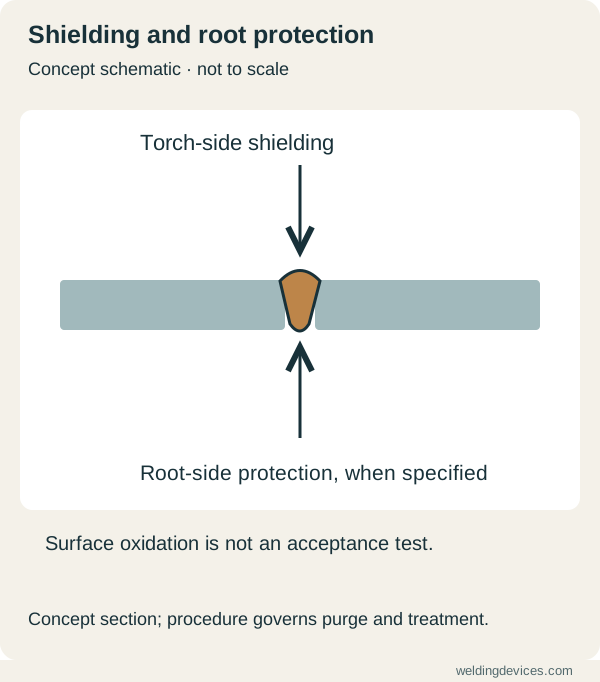
Schematic; source.
Control the heat history
Austenitic stainless steel can be sensitive to distortion, especially in thin fabrications. Its welding heat cycle can also influence corrosion performance. Joint preparation, sequence and an appropriate procedure matter as much as a visually attractive bead.
Understand heat tint
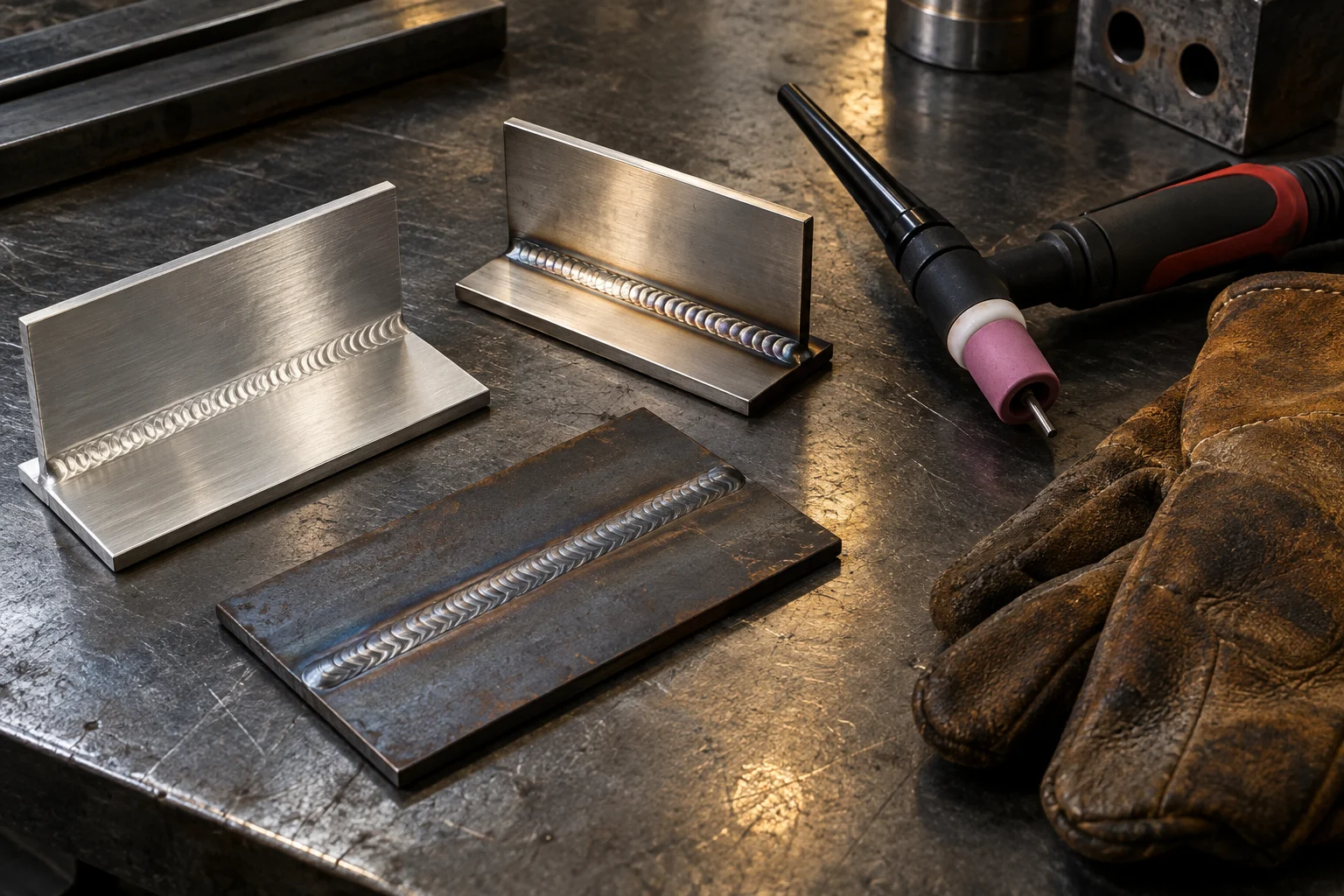
Colour near the weld is evidence of surface oxidation. For corrosion-sensitive service, the required condition of the finished surface needs to be established. Protective shielding and a suitable post-weld treatment may be part of that specification; surface colour alone cannot certify corrosion resistance.
Workshop example
For a decorative stainless bracket, ask what matters most: finish, dimensional accuracy or exposure conditions. For a food-contact or chemical-service item, obtain the actual requirements before treating it as an ordinary decorative project.
Questions worth resolving
- What exact stainless grade is on each side of the joint?
- Which filler and shielding arrangement does the procedure specify?
- Does a full-penetration joint need root protection?
- What cleaning, surface treatment and inspection are required?
Keep preparation tools suitable for stainless work and avoid introducing contamination. Make the finish requirement explicit before welding so that grinding or brushing does not become an improvised acceptance test.
Start with a material record
Put the grade, thickness and intended use on the work sheet before discussing machine settings. If the supplier provides material documentation, keep it with the job. A finish description such as brushed stainless tells you about appearance, not the alloy or suitability for the application. Unknown offcuts should remain clearly identified as unknown, particularly when a project has corrosion or service requirements.
Imagine making a small decorative cover and a part that will be exposed to a demanding cleaning environment. Both may be called stainless projects, but their requirements are different. Describe the exposure, finish and acceptance criteria to a competent adviser. This gives the filler and procedure discussion a concrete purpose and prevents a familiar consumable from becoming the default simply because it is already on the shelf.
Organise preparation tools
Keep suitable brushes, abrasives and handling methods available for stainless work. Label tools where that helps prevent accidental sharing with other materials. Arrange a clean area for prepared edges and identify how parts will be held. Good organisation reduces the chance that a carefully prepared surface picks up contamination during fitting or handling.
Make the routine visible: identify the material, follow the specified cleaning method, inspect the prepared joint and fit it to the drawing. Read product instructions before using a chemical cleaner. Surface treatment can introduce its own hazards and may need specialist facilities. A general welding article cannot select a chemical process for your particular grade and environment.
Practise control before appearance
Use consistent identified coupons for supervised practice. Choose the setup and technique from the relevant procedure or instructor's guidance. Record the machine configuration, filler, shielding and sequence. Start with a joint you can see and reach comfortably. Watch how the technique changes as the coupon warms, and record when you pause or restart.
The goal is a repeatable result with appropriate inspection. An attractive colour pattern or evenly spaced ripples may be interesting, but neither demonstrates corrosion performance or internal soundness. Keep separate notes for appearance, dimensions and any inspection result. That distinction makes the next lesson more useful: you can discuss the specific requirement that was missed rather than simply asking how to make the bead prettier.
Plan the reverse side and final surface
Some applications need particular protection or treatment beyond the visible face of the joint. Establish those requirements before fitting the parts. Ask whether the procedure calls for root shielding, how access will be provided and how the finished surface will be assessed. These questions belong in the job plan, rather than becoming improvised answers after welding.
Include finishing in the quotation and schedule. Brushing, grinding or a specialist treatment should follow an appropriate method for the job. Do not treat removal of a visible colour as proof that every corrosion concern has been resolved. Ask who is responsible for the final surface condition and what evidence will be supplied. The answer may change the equipment and service package you need.
Review a small sample properly
Give each practice sample a label and keep the material description attached to it. Photograph both accessible sides after it has cooled sufficiently for safe handling. Record joint dimensions, visible discontinuities and changes in fit-up. Where the application requires further examination, have a competent person choose and perform it. A practice photograph is a record, not a certificate.
Use the TIG lesson for coordination or the joint preparation lesson for a checking routine. Then return to the grade-specific requirements with your trainer. A good stainless workflow connects material identification, preparation, welding, finishing and inspection. Leaving any one of those stages vague makes an otherwise careful equipment choice less useful.
Put the choice in context.
Try the welding process finder to narrow your equipment research, or compare a complete setup in the ownership cost calculator.
References
Open the publisher’s page. If a new tab fails, use “Open directly” or copy the address into your browser.
- TWI — Welding austenitic stainless steel, part 2Opens the source in a new tabtwi-global.comLink checked · 31 Oct
- TWI — Avoiding heat tint · sourceOpens the source in a new tabtwi-global.comLink checked · 31 Oct
