
In this guide
Reader question
How can I tell that a TIG tungsten electrode is contaminated, and what should I do before restarting the weld?
Learning objective
After this lesson, you should be able to recognise the main contamination clues, stop without creating another problem, and choose a safe re-preparation step from the instructions for your exact electrode and power source.
Direct answer
Stop when the tungsten touches the molten pool or filler wire, when foreign metal is visible on the tip, or when a previously steady arc becomes erratic after a tip change. Let post-flow finish, make the equipment safe as its manual requires, then inspect the electrode. Remove the affected end and reprepare it with dedicated equipment, or replace it, following the electrode and machine instructions. Do not try to “burn through” a suspected contamination problem.
TIG, also called GTAW, normally uses a non-consumable tungsten electrode: it carries the arc rather than supplying filler metal. A tungsten inclusion is tungsten transferred into the weld. TWI explains that contact during starting can damage or stick the tip and may create an inclusion; its overview also notes that lift-arc starting limits this risk by making contact at a very low current (TWI TIG process guide).
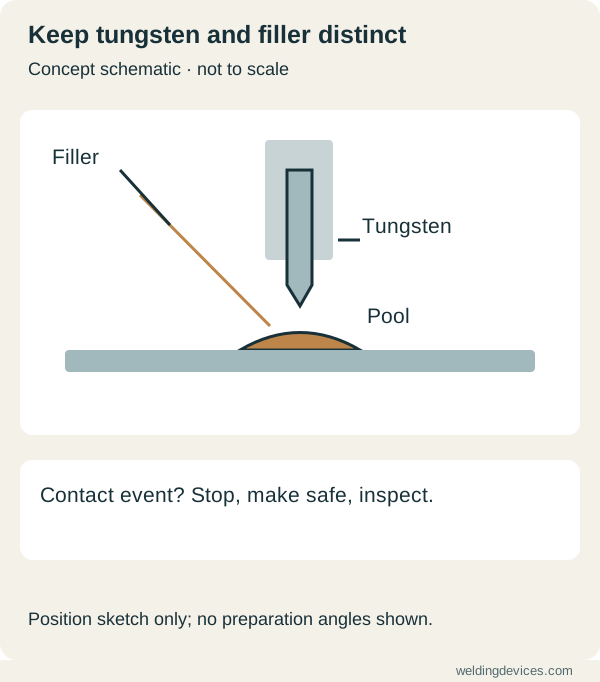
Schematic; source.
Separate a trigger from a symptom
A trigger is an event that makes contamination likely. The clearest triggers are dipping the electrode into the weld pool, touching it with hot filler, or dragging it during an uncontrolled scratch start. A symptom is what you notice afterwards: deposited metal on the tip, an altered tip profile, wandering arc behaviour, or a change in arc stability.
Do not diagnose every unstable arc as dirty tungsten. Shielding-gas loss, a poor work connection, wrong polarity, unsuitable electrode size, or a damaged torch can also disturb the arc. Work methodically: note what happened immediately before the change, then check the electrode before changing several unrelated settings.
Starting method matters. In its instructions for the TransTig 170/210, Fronius says HF ignition starts without electrode-to-work contact and contrasts this with contact ignition, which can contaminate the electrode and workpiece. The same manual lists wrong tungsten polarity and missing or incorrect shielding gas as causes of tungsten melting or inclusions during ignition (Fronius TransTig 170/210 instructions). Those remedies are model-specific; use your own machine manual rather than copying a socket or setting from another model.
A safe reset sequence
- End the arc normally. Keep the torch in position while the programmed post-flow runs. Post-flow protects the hot electrode and weld area; do not interrupt it merely to inspect faster.
- Make the system safe. Follow the shutdown and isolation steps in the exact power-source and grinder instructions. A tungsten electrode can be electrically live while the source is on.
- Inspect in good light. Look for attached filler or parent metal, a split or misshapen end, and a profile that differs from the prepared electrode you started with.
- Reprepare or replace. Remove enough material to eliminate the affected portion, then reproduce the tip geometry required by the electrode maker, process specification and machine manual. If damage extends too far or the remaining electrode is unsuitable for secure clamping, replace it.
- Control grinding dust. TWI’s guidance for thoriated tungsten identifies grinding dust as the main radiological concern and calls for a dedicated grinding setup with local extraction and suitable protection. Treat thoriated electrodes as a special case and follow current workplace rules and the supplier safety information (TWI thoriated-tungsten guidance).
- Check the cause before restarting. Confirm gas supply, torch parts, work return, polarity and starting mode against the applicable instructions.
There is no single universal regrind interval. The Australian Welding Institute’s anodised-aluminium article says to regrind when the prepared tip rounds and the arc becomes unstable, but that guidance is explicitly for that aluminium application (AWI, 18 February 2019). Other materials, currents and electrode types may call for a different tip shape.
Worked example: a filler-wire touch
Imagine a learner making a DC TIG practice bead on clean carbon steel. Halfway through, the filler wire touches the tungsten. The next restart produces a wandering arc.
The useful evidence is the sequence: a known contact event followed by changed arc behaviour. The learner ends the arc, allows post-flow to finish, follows the machine’s safe shutdown procedure and inspects the tip. A bright deposit is visible on one side. Instead of raising amperage or gas flow, the learner removes the contaminated end using the shop’s dedicated tungsten-preparation equipment, restores the specified geometry, cleans the work area and checks that the filler can enter the leading edge of the pool without crossing the electrode. A test restart on practice material is stable. This is a hypothetical diagnosis, not a recommended setting.
For broader torch control and terminology, review TIG welding basics. If the job uses alternating current, also read AC/DC TIG controls before changing balance or frequency.
Practical checklist
- Stop after a known pool or filler contact.
- Let post-flow complete.
- Isolate equipment as the manuals require.
- Inspect for transferred metal and tip damage.
- Use dedicated preparation equipment.
- Control dust, especially with thoriated tungsten.
- Restore only the specified tip geometry.
- Check gas, polarity, torch condition and work return.
- Test on suitable practice material before returning to the joint.
- Escalate critical-work acceptance to the governing procedure or welding coordinator.
Self-check
Question: The arc becomes unstable immediately after the filler touches the tungsten. Should you first increase current to stabilise it?
Answer: No. End safely, inspect and reprepare or replace the contaminated electrode as required, then verify the related setup. Increasing current does not remove transferred metal and can hide the original cause.
Put the choice in context.
Try the welding process finder to narrow your equipment research, or compare a complete setup in the ownership cost calculator.
References
Open the publisher’s page. If a new tab fails, use “Open directly” or copy the address into your browser.
- TWI: What is Tungsten Inert Gas (GTAW or TIG) Welding? · TWI TIG process guide · sourceOpens the source in a new tabtwi-global.comLink checked · 31 Oct
- Fronius: TransTig 170 / 210 operating instructions · Fronius TransTig 170/210 instructionsOpens the source in a new tabmanuals.fronius.comLink checked · 31 Oct
- TWI: The use of thoriated tungsten electrodes · TWI thoriated-tungsten guidanceOpens the source in a new tabtwi-global.comLink checked · 31 Oct
- Australian Welding Institute: GTAW of anodised aluminium · AWI, 18 February 2019Opens the source in a new tabwelding.org.auLink checked · 31 Oct