In this guide
Your MIG bead can change even when voltage and wire-feed settings stay untouched because moving the gun changes the length of electrically resistive wire between the contact tip and the arc. On a constant-voltage GMAW system, that change can alter welding current. The practical rule is simple: use the distance stated for your exact machine, wire, transfer mode and procedure, then hold it consistently.
Learning objective: Distinguish electrode extension, stickout and contact-tip-to-work distance (CTWD), then use those terms to diagnose a changing MIG arc without guessing at machine settings.
Three distances that are often confused
Electrode extension is the length from the end of the contact tip to the point where the wire melts. Stickout is measured from the nozzle end to that melting point. Those distances are equal only when the contact tip is flush with the nozzle. CTWD is normally treated as the distance from the contact tip to the work before the arc is struck; during welding, it includes electrode extension plus arc length. Miller explains these distinctions and notes that CTWD itself is not defined in AWS A3.0, despite its widespread use in procedures (Miller, 8 November 2024).
That terminology matters. If one person measures from the nozzle while another measures from the contact tip, they can follow the same written number but create different wire lengths. Record where the contact tip sits relative to the nozzle before comparing results.
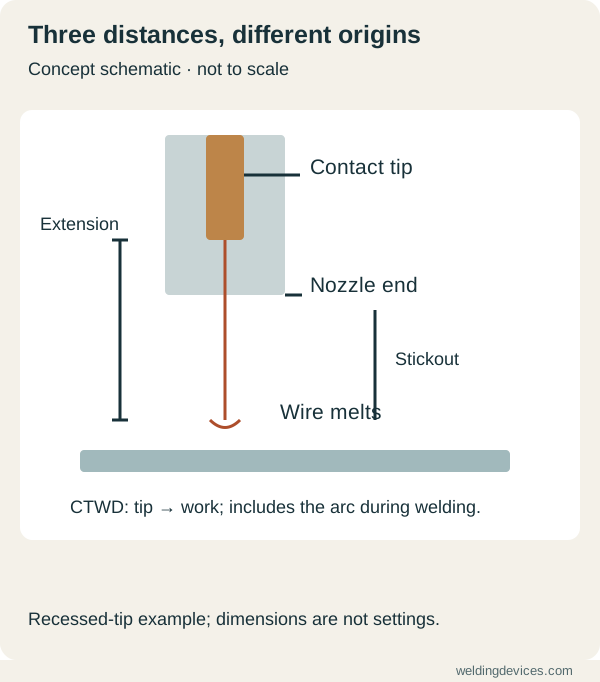
Schematic; source.
Why a longer extension changes the arc
The contact tip transfers current into the continuously fed wire. TWI explains that an oversized or worn tip bore can disturb current pickup, which is why the tip should be inspected and replaced when wear becomes excessive (TWI, updated web article checked 22 October 2026).
On a constant-voltage GMAW system, increasing electrode extension adds electrical resistance and heats more wire before it reaches the arc. Miller states that greater extension lowers amperage, while a shorter extension raises it. In Miller’s specific spray-transfer example—not a universal setting—changing CTWD from 5/8 to 1 inch shifted current from 282 to 213 amperes, with the other listed conditions held constant (Miller).
This is why an operator can see a bead change while the machine display appears unchanged. Distance is one of the welding variables. It should be checked alongside travel speed, gun angle, wire feed, voltage, gas delivery and surface condition—not used as a single explanation for every defect.
Use the number for the actual setup
Do not turn one handbook value into a rule for every machine or wire. Lincoln Electric’s MIG PAK HD manual instructs users of that model to maintain about 3/8–1/2 inch (10–12 mm) contact-tip-to-work distance in its learning sequence (Lincoln Electric IM822, MIG PAK HD, pp. 16 and 21–24). Miller’s Millermatic 355 manual gives different ranges by transfer mode: 1/4–1/2 inch for short circuit and 1/2–3/4 inch for spray transfer (Miller OM-288360, pp. 64–70).
These are manufacturer instructions for named products and contexts. Your welding procedure specification, wire datasheet and exact equipment manual take priority. If you are still building basic control, revisit the MIG/MAG first-practice lesson before changing several variables at once.
Hypothetical worked comparison
Imagine a learner making two labelled beads on clean practice coupons with the same approved machine settings, joint, wire, gas and travel plan. Bead A is made while holding the procedure’s specified CTWD steadily. During Bead B, the gun gradually moves farther from the work.
The learner should not declare the second bead “bad because voltage is wrong.” Instead, the note should say what was observed: distance increased, the arc behaviour changed, and the bead appearance became less consistent. The next controlled trial restores the specified distance while keeping the other recorded variables unchanged.
If the arc still hunts with a steady distance, inspect the feed path and contact tip rather than continuing to compensate with hand position. The wire-feed troubleshooting guide separates slipping, birdnesting and burnback symptoms. For holes or trapped gas, follow the porosity troubleshooting sequence instead of assuming CTWD is the only cause.
Practical CTWD checklist
- Read the exact machine, wire and procedure instructions before choosing a distance.
- Confirm whether the measurement starts at the contact tip or nozzle.
- Note whether the contact tip is flush, recessed or protruding.
- Measure during setup with the equipment safely inactive; do not place a gauge into a live arc.
- Brace the gun or support both hands where the work permits.
- Keep travel angle and speed steady while checking distance.
- Inspect the tip for wear and the nozzle for spatter before changing settings.
- Change one variable at a time on noncritical practice work.
- For production or code work, follow the approved procedure and escalation rules.
Self-check
Question: Two operators both write “12 mm stickout,” but one measures from a recessed nozzle and the other from the contact tip. Have they controlled the same variable?
Answer: No. They used different reference points. Record electrode extension or CTWD precisely, including the contact-tip position, then compare against the correct procedure or model manual.
Put the choice in context.
Try the welding process finder to narrow your equipment research, or compare a complete setup in the ownership cost calculator.
References
Open the publisher’s page. If a new tab fails, use “Open directly” or copy the address into your browser.
- TWI — Equipment for MIG welding · TWI, updated web article checked 22 October 2026Opens the source in a new tabtwi-global.comLink checked · 31 Oct
- Lincoln Electric IM822 — MIG PAK HD manual · Lincoln Electric IM822, MIG PAK HD, pp. 16 and 21–24Opens the source in a new tabch-delivery.lincolnelectric.comLink checked · 31 Oct
- Miller OM-288360 — Millermatic 355 manual · Miller OM-288360, pp. 64–70Opens the source in a new tabmillerwelds.comLink checked · 31 Oct
